Ask a manager in Pune, Jaipur or Coimbatore how AI has changed their week and you'll often hear two answers in one breath. "It saves me hours." And then: "I've never been this busy." Both are true, and the second one is the real problem. This piece looks at what fresh survey data says about that gap, why more tool tutorials won't close it, and what AI training for managers in India should cover instead. You'll also get a five-step audit you can run with your own team this week. No software needed.
Are AI tools actually making Indian managers busier?
Yes, and the numbers are hard to wave away. Korn Ferry released the India findings of its Workforce 2026 Insights Report on 30 September 2026. The survey covers more than 16,000 professionals worldwide, including 2,000 in India, from individual contributors up to CEOs.
The good news first. In India, 79% of employees say they're more productive than a year ago, and 76% feel adequately trained to use AI (the global figure is 52%).
Now the other side of the same survey. 78% of Indian employees report significantly higher workloads over the past two years, against 62% globally. 73% say AI tools have increased the number of tasks expected in their role, and 72% say they're doing the work of more than one role.
Managers sit right in the middle of this. Among first-level supervisors and managers, 80% report significantly higher workloads, and 76% say AI has added to their task count.
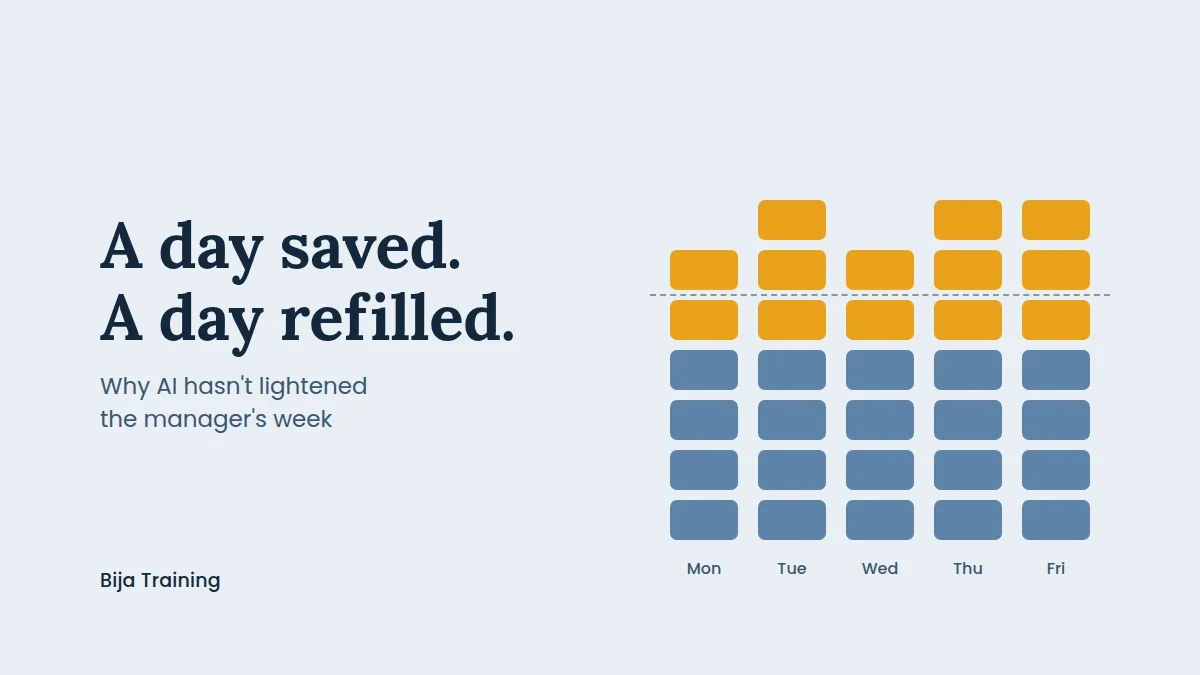
The tools aren't failing. BCG's AI at Work 2026 report found that 70% of frontline AI users in India save at least a full workday every week, the highest figure of any market it surveyed. So the time is being saved. It just isn't staying saved.
Where does the time AI saves actually go?
Into more work, mostly because nobody decided otherwise.
When a task gets faster, the freed hour has no owner. By default it belongs to whoever asks next: a senior, a client, an overflowing inbox. Korn Ferry's India consulting head draws the line between activity and impact. When each efficiency gain simply turns into extra work, he argues, a company can end up busier but no better off. We'd put it more bluntly. A faster treadmill is still a treadmill.
Two more numbers from the same survey show how deep this goes. 62% of Indian respondents say they're too busy to deliver meaningful results (45% globally), and 68% say existing processes and structures hold back their performance. That second figure matters. It tells you the problem isn't only the person. It's how the work is set up around them.
Here's an illustration, not a client story. Picture a sales manager at an auto-components supplier near Pune. She starts using AI to draft dealer follow-ups and weekly MIS summaries and gets back about six hours a week. Within a month her director adds two dealers to her territory and asks for daily reports instead of weekly ones, "since it's quick now." She's faster at everything and has no time left to visit a single dealer. Nothing broke. Nobody planned for the time, so it went to whoever asked.
Why doesn't regular AI tool training fix this?
Because it solves a different problem. Most AI training on offer teaches the tool: write sharper prompts, summarise documents, build slides in minutes. That's useful. It also explains how 76% of employees can feel trained while 62% feel too busy for meaningful work. Our read of those two numbers (it's our interpretation, not the survey's conclusion) is simple. People have learned to work faster. Nobody has taught them to decide what the faster work is for.
Managers need a different skill, and tool vendors rarely teach it: work design.
Microsoft's 2026 Work Trend Index offers a clue. In India, 32% of AI users are what Microsoft calls frontier professionals, double the global 16%. The report says frontier managers redesign team workflows around AI agents and automation, while other managers largely keep to conventional management methods and back AI use more lightly. The managers pulling ahead, in other words, aren't necessarily the best prompt writers. They're the ones rebuilding how the team works.
Korn Ferry's leaders argue much the same: plenty of companies have bolted AI onto existing jobs without rethinking the roles, workflows or performance measures around them.
And the pressure is rising on managers specifically. 70% of Indian employees say AI fluency is now being built into performance reviews, compared with 50% globally. Managers are being asked to judge something fairly that they were only ever shown how to use. That's a hard position to be in.
What should AI training for managers in India actually cover?
We'd put five things on the syllabus, in this order. If you're an HR or L&D head comparing options, it's a decent test of any programme, including ours. Our AI skills training for teams and leadership and manager development programmes are built around the same idea: tools second, work design first.
1. Work audits before prompts
Teach managers to break their team's work into pieces and decide who, or what, should own each one. Tool skills come second, and they land faster once you know what you're aiming the tool at.
2. Delegating to AI and checking the result
Good delegation to a person has a brief, a deadline and a review. AI needs the same. Managers should learn how to write a clear brief, what to spot-check, and which work should never run unreviewed: anything with a customer commitment, a compliance angle, or a number that reaches the board.
3. Protecting freed capacity
This is the missing piece in most programmes. Managers should practise deciding, up front, where reclaimed hours go. They should also practise the harder bit: saying "not yet" upwards when the request is simply more of the same.
4. Fair expectations and fair reviews
If AI fluency is going into appraisals, managers need a shared definition of "good". Without one, the person who quietly redesigns a process gets scored the same as the person who pastes outputs without reading them.
5. Honest conversations about job worries
Korn Ferry's India data holds a tension worth sitting with. 74% of employees believe using AI will raise their value over the next three years, yet 60% believe their role will be replaced by AI or technology in that same period. Both feelings live in the same team. A manager who can't talk about that gap openly will lose trust, no matter which tool the team uses.
Read Also: The Real Cost of Bad Management in Indian Companies.
How do you fix the workload trap? The Human, AI, Shared, Stop Audit
This takes about 90 minutes with one team. You need a whiteboard or a shared sheet.
Step 1: List the recurring work. Ask each person to write down everything they did in the last two weeks that repeats. Reports, follow-ups, approvals, reviews, data entry, meeting prep. Fifteen to twenty-five items each is plenty.
Step 2: Sort every item into one of four buckets.
- Human: needs judgement, a relationship or personal accountability. A difficult appraisal conversation. A vendor dispute.
- AI: first drafts, summaries, formatting, and routine analysis, with a named person checking the output.
- Shared: AI does the first pass; a person finishes and owns it.
- Stop: nobody would miss it. You'll find more of these than you expect. Reports nobody opens. Approvals that exist because of a rule from years ago.
Step 3: Count the freed hours, and decide where they go before anyone else does. Write it down. As a rule of thumb (ours, not a statistic), commit a fixed block of the reclaimed time to one named priority, such as dealer visits, coaching, or fixing a defect that keeps coming back. Treat that block as firmly as a client meeting.
Step 4: Reset what "done well" means. If the team now finishes the weekly report in an hour, don't automatically ask for it daily. Ask what decision the report supports and whether a faster cycle would change that decision.
Step 5: Review at 30 days with three questions. What did we stop? Where did the freed time actually go? What got better that a customer, a colleague or our own numbers could show?
Here's a second illustration, again not a real client. A team lead at an IT services firm in Hyderabad uses AI to write first-pass test cases, and drafting time drops sharply. After the audit, she moves the freed hours to reviewing the riskiest modules and to a weekly pairing session with junior testers. She tells her manager the plan up front. When someone asks whether the team can also take on an extra release, the answer becomes a conversation about trade-offs instead of an automatic yes.
What are the most common mistakes with AI training for managers?
Four we'd steer you away from.
Training managers last. Many companies train frontline users first and expect managers to work out the rules afterwards. But managers set targets, approve workloads and run reviews. They decide whether AI helps the team or burns it out. Train them first, or at least alongside.
Measuring hours saved. Hours saved is easy to count and says almost nothing about value. Count outcomes instead: turnaround time a customer notices, error and rework rates, and time spent coaching.
Treating AI as an IT rollout. Giving people access to a tool is an IT job. Changing how work gets done is a management job, and it needs its own owner.
Running one workshop and calling it done. A single session starts the conversation. Habits form when managers apply the audit to a real team and come back a month later to see what they held.
Run the audit above with one team before you buy anything. Ninety minutes of honest sorting will tell you a lot about where your managers' time is really going. If you'd like trainers to run it with your managers, in person or online, in any city across India, explore our corporate training programs or talk to our team.
Frequently Asked Questions
What should AI training for managers include?
It should cover work audits, delegating to AI with proper review, protecting the time AI frees up, setting fair expectations in reviews, and talking openly about job worries. Tool skills still matter, but they sit underneath those five. A manager who knows where AI belongs in the team's work will get more from the same tools than one who only knows the features.
Why do workloads rise even when AI saves time?
Because freed time has no owner. Unless someone decides otherwise, it gets absorbed by new requests, higher targets and faster reporting cycles. Korn Ferry's 2026 India findings show the pattern: 79% of employees say they're more productive, yet 78% report significantly higher workloads. Speed went up. How work is planned and measured didn't change.
Is AI training only for tech or IT teams?
No. Korn Ferry's India data spans individual contributors through CEOs, and managers in sales, HR, operations and finance all face the same question: what does the team do with time AI frees up? Training works best when it uses the team's own recurring tasks as the material, whatever the function.
How long should AI training for managers run?
One day can start the conversation, but habits form through use. We'd suggest a short kickoff, a work audit applied to a real team task, and a follow-up session around a month later to look at what changed. That follow-up matters more than most companies expect, because it's where freed time either gets protected or quietly disappears.
How do we measure whether manager AI training worked?
Skip hours saved. Look at outcomes your team already tracks: turnaround time customers notice, error or rework rates, and time managers spend coaching. Then ask the team one plain question after 30 days: is your workload more manageable, about the same, or worse? If it's worse, the training changed the tools but not the work.
Our leadership journeys combine diagnostics, coaching and measured follow-through. Talk to us about your team, or see how we run leadership development programmes for organisations across India.