The managing director of a ₹120-crore manufacturing business once told me he had not taken a holiday longer than four days in eleven years. He said it the way people say these things — half complaint, half boast.
Then he said the part that mattered: "If I am away for three weeks, I do not know who signs off a customer escalation."
That is not a holiday problem. That is a valuation problem, a continuity problem and a retention problem wearing a holiday's clothes. And it is what succession planning for small business is actually about — not who takes over when the founder retires in fifteen years, but who can run things on Tuesday.
Key Takeaways
- SME succession planning is not a retirement exercise. It is insurance against key-person dependency — and it works as retention insurance too.
- Most SMEs already have their next leader on the payroll; what is missing is a way to identify and prepare them.
- Potential and performance are different signals. Your best individual performer is often not your best successor.
- A workable pipeline needs only three tiers: ready now, ready in a year, worth watching.
- Ambitious people leave when they cannot see a path. Naming one is frequently cheaper than a counter-offer.
Succession Planning Isn't About Retirement
The phrase does the idea real damage. It sounds like estate planning — something for listed companies with a board committee and a consultant, relevant in a decade or so.
So it gets deferred, every year, for the entirely reasonable reason that this quarter's problems are louder.
Reframe it and the urgency becomes obvious. Succession planning answers a much more immediate question: if any one of our four or five critical people were unavailable from tomorrow, what happens? Not through disaster — through a competitor's offer, a health event, a family relocation, a founder who finally wants a month off. All of these are ordinary. None of them are rare.
Framed that way it stops being a fifteen-year question and becomes a this-year one.
The Real Risk: Key-Person Dependency
In most Indian SMEs, an enormous amount of operational knowledge lives in a handful of heads and nowhere else. Which customer tolerates a delay and which one escalates to the MD. Which supplier's quoted lead time is real. What the actual approval threshold is, as opposed to the one in the policy document.
None of this is written down. It does not need to be, while those people are present. It becomes a serious problem the moment they are not.
The commercial consequences are concrete. Key-person dependency shows up in due diligence and depresses valuations. It constrains growth, because the business cannot open a second location without cloning someone. And it quietly caps the founder's own options — you cannot step back from a business that cannot run without you.
Why SMEs Skip It — and Why Those Reasons Don't Hold
"We are too small." Size increases the risk rather than reducing it. A 2,000-person company losing a plant head has bench strength. A 200-person company losing its plant head has a crisis. Smaller organisations need this more, not less.
"We will hire when the time comes." Sometimes right — but external hiring into a senior SME role has a high failure rate, because so much of the job is relationship and context that no CV captures. It is also slow, and the time comes without notice.
"It will create politics." The most honest objection, and it has some substance. Naming a successor publicly can demotivate everyone not named. The answer is not to avoid the exercise but to keep the assessment private and the development visible — offer the stretch assignment without announcing the succession decision attached to it.
"Nobody here is ready." Usually true, and usually the wrong conclusion. Nobody is ready because nobody has been developed. That is an argument for starting, not for waiting.
Spotting Leadership Potential Early
The most common error is treating the performance ranking as the succession list. They measure different things.
Your highest performer is excellent at the job they currently hold. That is real information about their present role and surprisingly weak information about a different one. Potential is about trajectory — the capacity to succeed at work that looks nothing like what they do today.
Four signals that are worth more than a performance rating:
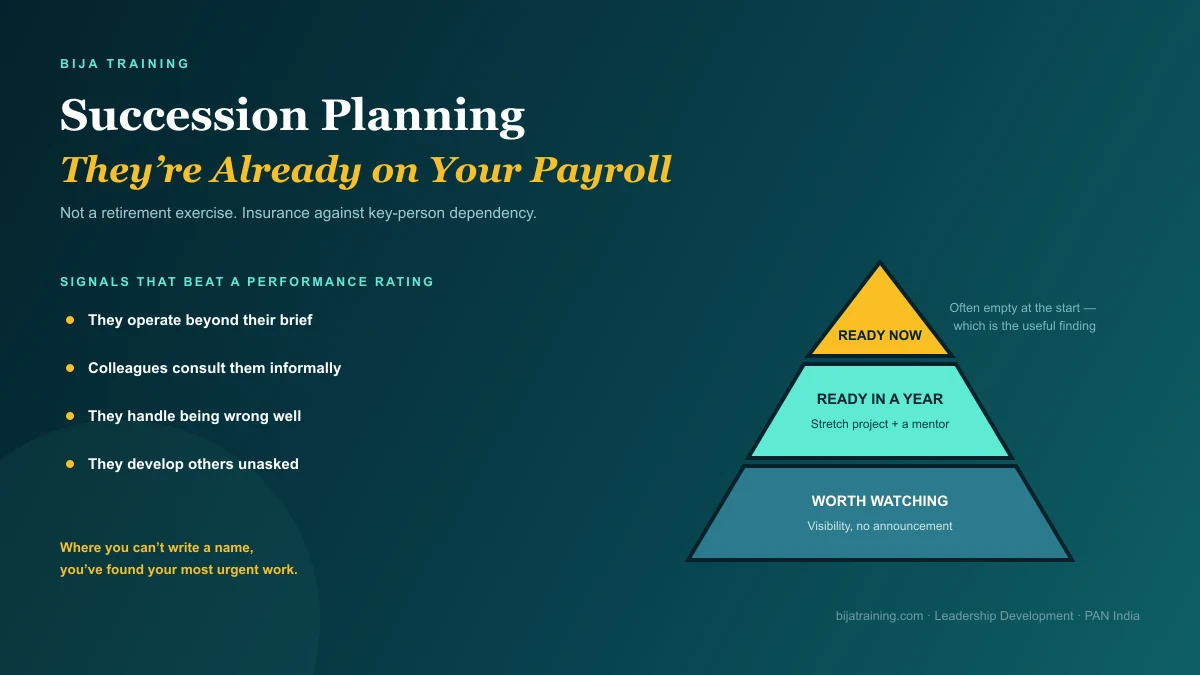
- They already operate beyond their brief. Not empire-building — they notice problems outside their remit and pick them up without being asked.
- People consult them informally. Watch where colleagues go when they are stuck. Influence without authority is the single hardest thing to teach and the easiest to observe.
- They handle being wrong well. Ask about a decision that did not work. People with real potential describe what they changed. People without describe what the circumstances were.
- They develop others without being asked. Someone who instinctively brings a junior along is already doing the job.
None of these appear in an appraisal form. All of them are visible to anyone paying attention for a quarter.
A Simple Pipeline You Can Actually Run
You do not need a nine-box grid or a talent management platform. The formal succession planning machinery large corporates run is built for a scale you do not have. For an organisation of a few hundred people, three tiers and an annual conversation will do almost all of the work.
Start by listing your genuinely critical roles — usually four to six. Not the senior-most titles; the ones whose sudden absence would hurt most. For each, place candidates:
Tier 1 — Ready now
Could step in within a month with support. Often nobody is here at the start, and that emptiness is the most useful output of the whole exercise.
For anyone in this tier, the development need is exposure rather than skill: let them run the function while the incumbent is on leave. A planned two-week handover is the cheapest continuity test available, and it tells you more than any assessment.
Tier 2 — Ready in a year
Has the raw capability and a visible gap — commercial exposure, people management, a functional blind spot.
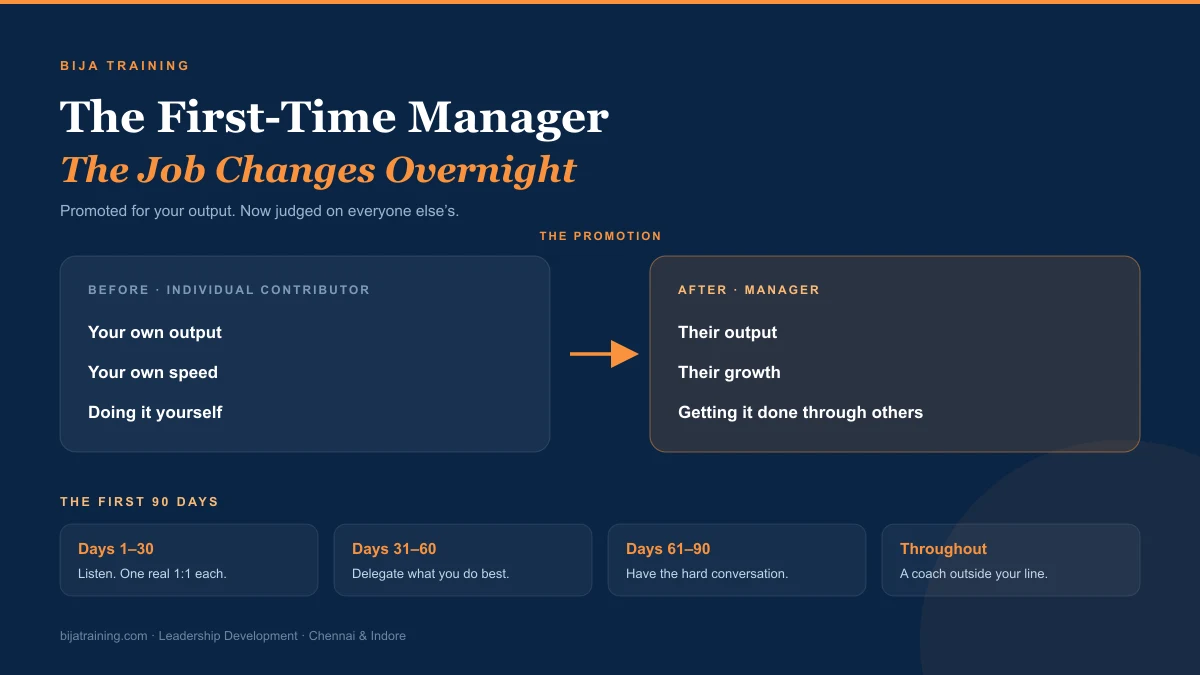
This tier is where deliberate development pays. A stretch project that forces the missing skill, a mentor from a different function, and formal input where the gap is behavioural. If the gap is managing people for the first time, that is a specific and well-understood problem — see our piece on the first ninety days of a new manager.
Tier 3 — Worth watching
Early-career people showing the four signals above. No commitment, no announcement. Just visibility, a conversation once or twice a year, and slightly harder problems than their role strictly requires.
The main thing Tier 3 protects against is losing someone good at year three because nobody ever indicated they had been noticed.
The Retention Argument
Here is the part that makes this worth doing even if nobody ever leaves.
Ambitious people in SMEs usually leave for one of two reasons: money, or the absence of a visible path. The second is more common than exit interviews suggest, because "I could not see where I would be in three years" sounds ungrateful and "I got a better offer" does not.
A succession pipeline is the most credible answer to the path problem, because it is not a promise — it is a plan with a name and a development conversation attached. That costs considerably less than a counter-offer and holds for longer.
The mechanism is mostly conversational, which is why the quality of those conversations matters. Getting the distinction right between directing someone and developing them is worth understanding properly; we cover it in mentoring versus coaching.
Frequently Asked Questions
What is succession planning for a small business?
Identifying which roles the organisation genuinely depends on, who could take them over, and what those people need in order to be ready. In an SME it is less about retirement and more about removing key-person dependency — the risk that a single unplanned departure disrupts operations.
When should an SME start succession planning?
Once any single person's sudden absence would materially disrupt operations, which for most businesses is well under 100 employees. The trigger is concentration of knowledge, not headcount. Waiting until someone resigns removes every option except external hiring under time pressure.
How do you identify leadership potential in existing employees?
Look for four observable signals rather than performance ratings: they operate beyond their formal brief, colleagues consult them informally, they describe what they changed after a decision went wrong, and they develop juniors without being asked. Performance describes the current role; potential predicts a different one.
Should you tell someone they are a successor?
Usually not explicitly, because plans change and an unfulfilled expectation does real damage. Keep the assessment private and the development visible — offer the stretch assignment, the mentor and the exposure without attaching a named promise to them.
What happens if you don't do succession planning?
You carry unpriced key-person risk: operational disruption on unplanned exits, external hires into senior roles with high failure rates, suppressed valuation in any diligence process, and attrition among ambitious employees who cannot see a path forward.
Where to Start
Take a sheet of paper. List the four or five people whose resignation on Monday would genuinely hurt. Against each, write the name of whoever would step in.
Where you cannot write a name, you have found your most urgent piece of work — and, in almost every SME we have done this with, at least one of those blanks is a real surprise to the person holding the pen.
We help SMEs across India identify internal successors and build the development plan that gets them ready — without the politics of a public announcement. Talk to us, or see how we structure leadership development programmes.