If you've ever had to defend an L&D budget in a CFO review, you know the discomfort. The questions sound innocent — "what did we get for that ₹40 lakh we spent last year?" — but they're really asking whether learning is a cost or an investment. And the honest truth is that most HR teams I work with don't have a great answer.
This isn't because HR people are bad at numbers. It's because measuring training ROI is genuinely hard. The variables are messy. The time lag is long. The attribution is fuzzy. And most of the frameworks we were taught at university — like the Kirkpatrick model — are conceptually sound but practically incomplete.
So let me share what we actually do with our clients to measure training impact in a way that holds up under scrutiny. None of it is magic, but together it's a framework that has gotten our clients meaningful budget conversations with CFOs who started out sceptical.
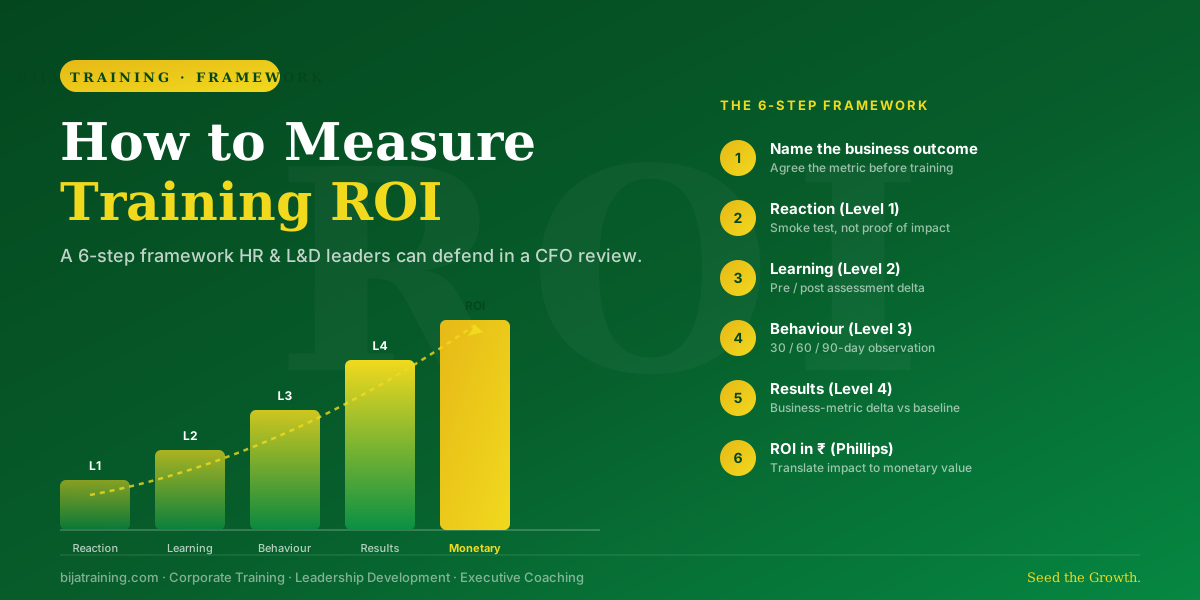
Start by Naming the Business Outcome
The most common mistake I see is measuring learning ROI without first naming what business outcome the training is meant to improve. "Improve communication" is not a business outcome. "Reduce customer escalations because frontline staff handle objections better" is.
Before you commission any program, sit down with the business leader who's sponsoring it and ask: "If this training works perfectly, what will be measurably better in your part of the business?" That question is uncomfortable for a reason — it forces specificity. And without specificity, you can't measure anything.
If your business sponsor can't name a metric they'd expect to see move within 6 months of the training, the training probably isn't necessary — or the wrong stakeholder is sponsoring it.
The Four Levels — But Done Properly
Most HR teams have heard of Kirkpatrick's four levels of evaluation. They're a useful starting frame, but they're often applied superficially. Let me show you how we use them in practice.
Level 1: Reaction (and why "happy sheets" mostly lie)
This is the post-training feedback form: "How would you rate this program out of 10?" These are useful for catching obviously bad facilitators or broken logistics. They're nearly useless for measuring actual learning impact. People rate programs highly when they enjoyed them, not when they changed because of them. We collect Level 1 data, but we don't make decisions on it.
Level 2: Learning
Did participants actually acquire the skills or knowledge the training intended? A pre-test before the program and a post-test immediately after gives you a delta. It's not perfect (people often forget what they learned within weeks), but it tells you whether the content was absorbed at all. Many programs fail Level 2 — participants attended but didn't really learn anything new.
Level 3: Behaviour (this is where the truth lives)
Did participants actually change how they behave at work? This is the most important level and the hardest to measure. We do it three ways:
- Manager observation surveys at 30, 60, and 90 days post-training, asking specific behavioural questions ("Has the participant initiated more difficult conversations than before?" rather than "Has the participant become more assertive?")
- Self-tracking commitments made at the end of training and reviewed weekly
- Behavioral tracking via our HR portal, which captures specific events ("conducted skip-level conversation," "delivered constructive feedback") tagged to participants
Level 4: Results (the business outcome)
Did the named business outcome actually improve? This is where you compare the pre-training baseline to post-training reality on whatever metric you named at the start. If you trained sales managers in objection handling and your win rate on contested deals went from 32% to 39% over the following two quarters, that's your Level 4 evidence.
The Phillips Addition: Translating to Money
Jack Phillips added a useful fifth level: convert the business result into rupees. This is what CFOs actually want to see.
If your customer service training reduced escalation rate by 18%, and each escalation costs you roughly ₹3,500 in resolution time and customer goodwill, and you handle 12,000 escalations a year — that's about ₹75 lakh in avoided cost. Compare that to a training spend of ₹8 lakh, and your ROI conversation suddenly looks very different.
The math is approximate. You'll get pushback on the assumptions. But the directional signal is what matters, and the discipline of even attempting this conversion changes how seriously L&D gets taken at the leadership table.
Three Practical Habits That Make This Work
Beyond the framework, three operational habits have made the biggest difference for our clients:
Establish a baseline before you train
If you only start measuring after the training, you have nothing to compare against. Whatever metric matters — engagement scores, NPS, sales conversion, defect rate, manager 360° scores — capture it before the program starts. Without this, any ROI argument falls apart on scrutiny.
Build measurement into the program design, not as an afterthought
The best training programs are designed backwards from the measurement plan. If you want to demonstrate impact on time-to-productivity for new hires, you design the onboarding training, the manager check-ins, and the tracking touchpoints together. Adding evaluation later, as a separate workstream, makes it both more expensive and less useful.
Tell stories alongside numbers
A CFO needs the numbers. But your CEO and your board are persuaded as much by stories as by spreadsheets. Three specific, sincere stories of "before this training, X — after this training, Y" do more to secure next year's budget than a 50-page measurement report. Collect them deliberately. Treat them as data.
What Not to Measure
A final practical note: not everything needs measurement. There are forms of learning — cultural induction, values alignment, executive coaching — where forcing rigid metrics distorts the work. Be honest about which programs are best evaluated quantitatively and which are best evaluated through qualitative judgement and observed culture shift over time. Trying to put a rupee value on everything ultimately undermines the case for L&D, because it turns every initiative into a tactical cost exercise.
Measure where measurement helps. Defend with stories where it doesn't. And keep the conversation with your leadership team focused on what matters: are your people getting more capable, more confident, and more committed — and is the business getting better because of it?
Every Bija Training engagement comes with a structured measurement plan built into the design. Talk to our team about designing programs that come with built-in ROI evidence — not measurement bolted on after the fact.