I once sat in on a project review where a delivery date was confirmed for the third time. Everyone nodded. The meeting ended early.
Six weeks later the project slipped by two months, and the post-mortem turned up something uncomfortable: at least four people in that room had privately believed the date was impossible. One of them had run the numbers. None of them said anything.
Nobody was incompetent. Nobody lied. The information that would have saved two months existed in the room and simply couldn't get out.
That is what psychological safety at work is really about. Not comfort, not niceness — whether the truth reaches the people who need it while there's still time to act.
What Psychological Safety Actually Means
The term comes from Harvard professor Amy Edmondson, who defined it in 1999 as a shared belief that a team is safe for interpersonal risk-taking. In plainer language: can you ask a question, admit a mistake, or say "I think this is wrong" without it costing you?
Two things about that definition matter more than people realise.
It is a property of a team, not a person. The same employee can be forthright in one team and silent in another, three floors apart in the same company. When someone is described as "not confident enough to speak up", it's worth asking which rooms they're quiet in — and which rooms they aren't.
And it's about cost, not comfort. The question isn't whether speaking up feels pleasant. It's what happens afterwards.
Google's Project Aristotle looked at what made some of its teams work better than others and found psychological safety to be the strongest single factor — ahead of who was on the team. That finding is documented publicly in their re:Work guide, and it's the reason the idea moved from academic literature into ordinary management conversation.
What It Isn't
The phrase gets misused often enough to be worth clearing up.
It is not being nice. Teams with high psychological safety usually argue more, not less — challenge is cheap when it isn't personally expensive. A team where everyone is polite and nobody raises problems has low psychological safety, not high.
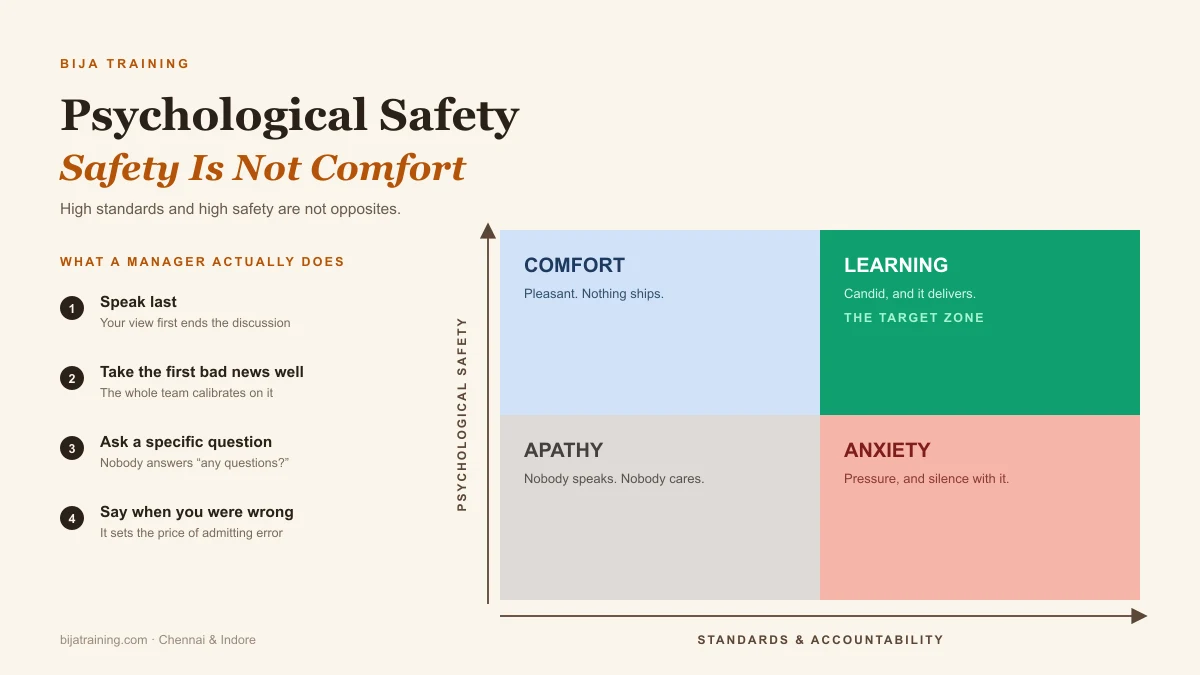
It is not lower standards. Edmondson's own framing pairs safety with accountability: high standards plus low safety produces anxiety; high safety plus low standards produces a pleasant, unproductive team. You want both.
And it is not something you can announce. Saying "my door is always open" changes nothing on its own. People judge by what happened the last time someone walked through it.
Four Signs Your Team Doesn't Have It
Surveys are useful but slow. These four signals are visible in a fortnight if you look for them.
Bad news always arrives late. Problems reach you at the point where they can no longer be solved quietly. If you routinely learn about a slipping deadline in the week it slips, people are not choosing to hide things — they're waiting until the news is undeniable, because delivering it earlier feels riskier.
Real questions come after the meeting. You ask if there are any questions, get none, and then three people catch you in the corridor. The room is where the questions were, and the room is where they weren't asked.
Nobody disagrees with the senior person. Watch what happens when the most senior person in the room states a view early. If agreement is instant and total every time, you're not watching consensus — you're watching hierarchy.
Mistakes surface as surprises. Errors are being managed quietly rather than raised. Which means small correctable ones get absorbed, and you only hear about the ones too large to absorb.
Why This Is Harder in Indian Workplaces
It's worth naming honestly, because ignoring it makes the advice useless.
Deference to seniority and to age is a genuine strength in Indian organisations — it supports mentorship, continuity and a kind of institutional patience that flatter cultures often lack. It also means the default distance between a junior employee and a senior one is larger, and disagreement carries more social weight.
Sixteen years of education reinforces it. Nobody arrives at their first job having practised contradicting an elder in public.
None of that has to be dismantled. The goal isn't informality for its own sake — it's making sure that respect doesn't quietly become silence about things that matter. That distinction is worth being explicit about with a team, because most people can hold both if you say it out loud. We cover the individual half of this skill in our piece on the art of assertiveness; this article is about the manager's half, which matters more.
Four Things a Manager Can Do
1. Speak last
If you state your view first, you've ended the discussion — everyone after you is now either agreeing with the boss or contradicting them. Ask the question, then be quiet. It's the cheapest intervention on this list and the hardest to actually do, because the silence is uncomfortable and you will want to fill it.
Count to ten before you do. Someone usually speaks by seven.
2. Handle the first bad news well
At some point someone will bring you a problem early, at some risk to themselves. What you do in those thirty seconds sets the price of candour for the next year, and everyone will hear about it by lunchtime.
Thank them first, explicitly and before anything else. Ask what they need. Deal with any question of fault later, separately, and only if it's genuinely relevant. If your first reaction is "why am I only hearing this now?", you have answered your own question — that's why.
3. Ask a specific question
"Any questions?" is not a question; it's a closing formality, and everyone treats it as one.
Replace it with something that has an actual answer. What's the part of this plan you're least confident about? If this slips, where would it slip first? What would you do differently if it were entirely your call?
Specific questions give people permission to raise a concern without it looking like an objection. That distinction sounds small and does most of the work.
4. Say out loud when you were wrong
Not performatively, and not constantly. Once in a while, in a normal tone: "I pushed that timeline and it was the wrong call."
You're demonstrating what admitting a mistake costs in this team. If it costs the senior person nothing visible, it becomes affordable for everyone else. This one behaviour does more than any workshop we could run — and it's a recurring theme in the habits that separate good managers from great ones.
Frequently Asked Questions
What is psychological safety at work?
The shared belief within a team that it's safe to speak up, ask a question, admit a mistake or disagree without being punished or humiliated. Defined by Harvard professor Amy Edmondson in 1999. It's a property of the team, not the individual — the same person can be candid in one team and silent in another.
How do I know if my team lacks it?
Four signals: bad news reaches you only when it can no longer be fixed; real questions get asked in the corridor rather than the room; nobody disagrees with the most senior person present; and mistakes surface as surprises. Any one is worth investigating.
Is psychological safety the same as being nice?
No. It's about the cost of speaking, not the comfort of the conversation. Safe teams often disagree more openly and hold higher standards, because challenge carries no personal penalty. A team where everyone is polite and nobody raises problems has low safety, not high.
How can a manager build it?
Speak last, so your view doesn't close the discussion. React well the first time someone brings bad news — the team calibrates on that reaction. Ask a specific question instead of "any questions?". And say out loud when you were wrong, which lowers the price of admitting error for everyone.
How long does it take?
Expect three to six months of consistent behaviour before people test it seriously — and it can be lost in a single meeting. Safety is built on repeated evidence, not announcement. One bad reaction after three months of encouragement usually returns the team to silence.
Where to Start
Pick your next team meeting. Ask one specific question — not "any questions?" — and then stay quiet for ten full seconds.
If nobody speaks, that's your answer, and it's a more useful one than any survey would have given you. If someone does, notice what it costs you to hear it well. That reaction, repeated, is the whole thing.
Our behavioural and leadership programmes work on both halves of this — managers who make it safe, and team members who can raise things clearly. Talk to us about your team, or see our leadership development and executive coaching approach.