One of the best workshops I've ever run was also one of the most useless.
Two days, thirty managers, an engineering company outside Pune. The room was genuinely alive — people arguing, testing things on each other, staying past six on the first evening. Average rating 4.7. The HR head sent a thank-you note the same week.
I went back seven weeks later for an unrelated session. Nothing had changed. Not a little — nothing. The same managers were running the same meetings the same way they had before I arrived.
That taught me something I now say to clients before they book anything: the workshop is the easy part, and it is almost never where programmes fail.
The Problem Isn't the Workshop
When training doesn't work, the instinct is to look at the content or the trainer. Sometimes that's fair. Far more often the two days were fine and the six weeks afterwards were empty.
Think about what actually has to happen for training to change anything. Someone has to remember it. They have to notice a moment where it applies — often while under pressure. They have to choose the new behaviour over the old one, which will feel slower and more awkward. And then it has to go well enough that they try again.
None of that happens in the training room. All of it happens in the weeks after, and most programmes are designed as though those weeks don't exist.
Why Learning Fades
Four reasons, and they compound.
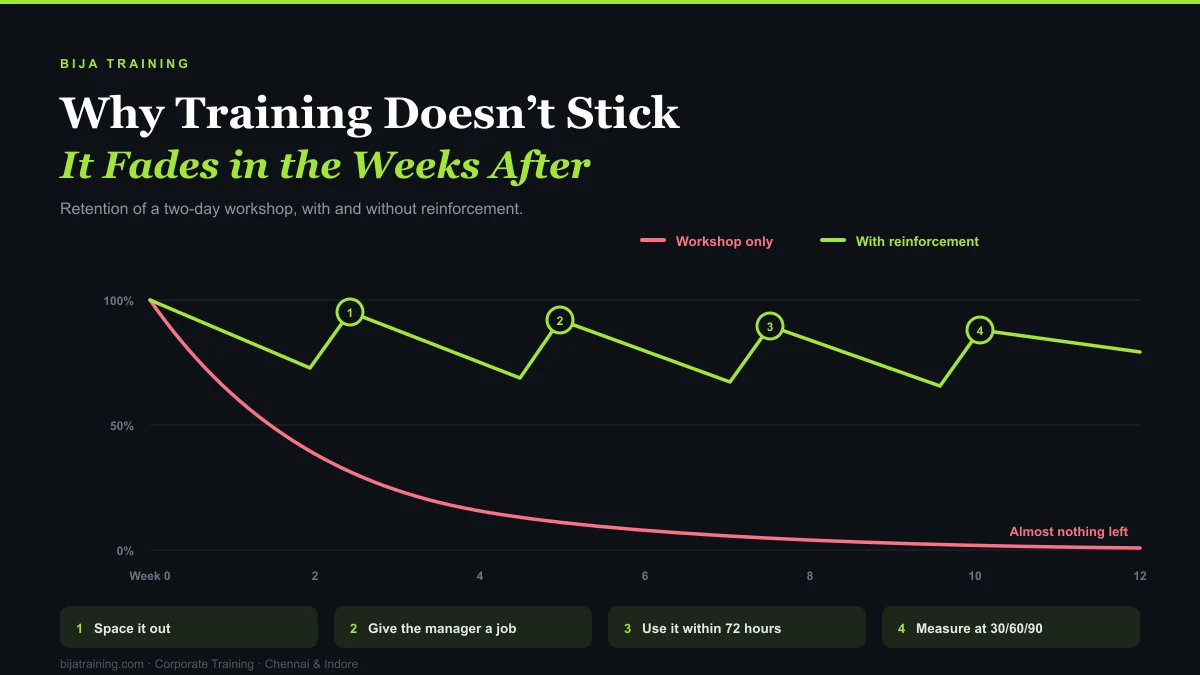
Everything at once, then nothing. A two-day workshop is a single exposure. Hermann Ebbinghaus mapped the forgetting curve in the 1880s and the shape has held up ever since: without a second exposure, most of what you learn is gone within days. Spacing is not a nice-to-have. It is the mechanism.
The manager was never involved. Someone spends two days learning to raise problems earlier, returns on Monday, and their manager doesn't know they went. Nobody asks what they learned. Nothing in the environment signals that anything is expected to be different.
No chance to use it. A manager learns how to give difficult feedback, and the next genuinely difficult conversation is five weeks away. By then the specifics are gone and they fall back to what they've always done.
Measured on the wrong day. The feedback form at 5pm on day two measures whether people enjoyed themselves. It correlates poorly with whether anything changed. We've written separately about what to measure instead and when.
Four Moves That Make Training Stick
None of these are expensive. Most cost less than the content they replace.
1. Space it out
Take the same two days and spread them across six weeks — four half-days, roughly a fortnight apart. Same facilitator time, same cost, substantially better retention.
The gaps do most of the work. Each session ends with something to try before the next one, and each session opens with what happened when they tried it. That opening conversation is usually the most valuable twenty minutes of the whole programme, because it's the only part built on real attempts rather than hypotheticals.
It's harder to schedule. That's the real objection, and it's worth overcoming.
2. Give the manager a job
Not encouragement — a defined task. Something like: a fifteen-minute conversation each week for six weeks, with three questions. What did you try? What happened? What will you try next week?
Brief the managers beforehand, ideally in a ninety-minute session. Tell them what their people are learning and, more importantly, how to react the first time they see it. A manager who responds badly the first time someone raises a risk early has ended the programme for that person. One reaction outweighs six weeks of content.
This is the step most often cut for time. It's also the one with the largest effect, which is a frustrating combination. If you can only do one thing from this list, do this one — and if you're building manager capability more broadly, it connects directly to the habits that separate good managers from great ones.
3. Make them use it within 72 hours
Before people leave the room, each person commits to one specific application on real work, within three days. Not "I'll communicate better." Something like: "I'll write Thursday's project update using the structure we practised, and send it to the group."
Then they report back — one line to the group or the facilitator. The reporting matters as much as the doing, because a commitment someone else will ask about actually gets done.
Seventy-two hours isn't arbitrary. It's roughly the window in which the detail is still available. After a week, people remember that there was a structure but not what it was.
4. Measure behaviour at 30, 60 and 90 days
Three short checkpoints, three or four questions each, to the participant and their manager. Are you still doing it? Where does it work? Where does it break down?
This does two things. It tells you honestly whether the programme worked. And — this is the part people underestimate — the checkpoints themselves are reinforcement. Knowing someone will ask at day 60 keeps a behaviour alive through the awkward middle stretch.
What to Cut to Pay for It
The usual objection is that there's no budget for reinforcement. Almost always there is; it's currently being spent on content.
Most two-day programmes cover far too much. Eight topics, of which participants might genuinely adopt one or two. Cut it to three topics and use the recovered time for spacing, practice and follow-up. You'll cover less and they'll do more.
That trade is uncomfortable for whoever approved the budget, because a fuller agenda looks like better value on paper. It isn't. Half-remembered exposure to eight ideas changes nothing; properly reinforced exposure to three changes how someone works.
It's the same reason generic programmes underperform — they're designed to look comprehensive rather than to change anything. And if you're not yet sure which three topics matter for your team, that's a training needs analysis question, not a curriculum question.
Frequently Asked Questions
Why doesn't corporate training stick?
Four reasons, none about workshop quality: content delivered in one block with no second exposure; the line manager uninvolved and never asking; no chance to apply the skill within days; and success measured by a satisfaction form on the last afternoon instead of by behaviour weeks later.
How do you make training stick?
Space delivery out — four half-days across six weeks beats one two-day block. Give the line manager a defined role, usually a fifteen-minute weekly conversation. Require each participant to apply the skill on real work within 72 hours and report back. Measure behaviour at 30, 60 and 90 days.
How long before training becomes a habit?
Plan for about 90 days of reinforcement. Habit-formation research suggests new behaviours need roughly two to three months of repetition to become automatic, and workplace behaviours involving other people sit at the longer end. A programme that ends with the workshop has covered only the first few days of that.
What role should the line manager play?
The largest one. They need to know what was taught, ask about it weekly, and respond well the first time the new behaviour appears. A single dismissive reaction can undo weeks of content — which is why briefing managers beforehand matters more than most organisations expect.
Is reinforcement expensive to add?
Usually cheaper than the content it replaces. Splitting two days into four half-days costs about the same facilitator time; manager briefings take around ninety minutes. Most organisations fund reinforcement by cutting content volume — which improves retention rather than reducing it.
Where to Start
If you have a programme running now, don't redesign it. Add one thing: a fifteen-minute weekly conversation between each participant and their manager, for six weeks, with those three questions.
It costs an hour and a half per person in total. In my experience it does more for transfer than any change you could make to the content itself.
We build reinforcement into every programme by default — spaced sessions, manager briefings, and 30/60/90-day behaviour checks. Tell us what happened last time, or see how we structure in-house programmes and executive coaching around what actually transfers.