A plant HR manager once told me something that stuck. He said his new engineering hires could calculate anything you put in front of them, but not one of them would walk up and tell him a machine was making a strange noise. They'd wait for someone senior to notice.
That's the campus-to-corporate gap in one sentence. It's almost never about technical ability. It's about the dozen small workplace behaviours nobody ever taught them — and that everyone assumes they'll just pick up.
Most do pick them up. It just takes eighteen months of awkward mistakes, and some of them quit before they get there. A structured campus to corporate programme compresses that into about ninety days.
What Freshers Actually Arrive Without
When we interview fresh hires and their managers before designing a programme, the same four gaps come up almost every time. None of them are academic.
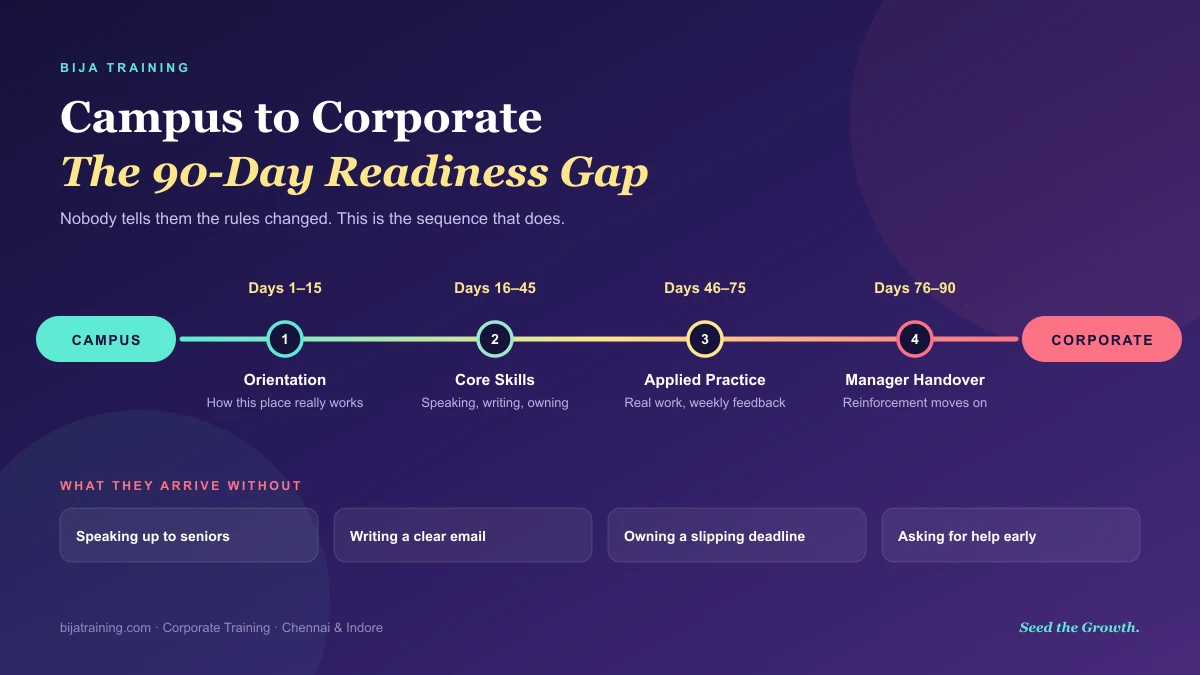
Speaking up to someone senior. This is the big one in Indian workplaces, and it's cultural, not personal. Sixteen years of education taught them that the person at the front of the room has the answers and you don't interrupt. Then they join a company where staying quiet about a problem is the most expensive thing they can do. Nobody tells them the rules changed.
Writing a clear work email. They can write a 3,000-word assignment. Ask for six lines that tell a busy manager what happened, what it means, and what you need from them — and it falls apart. College never asked them to write for someone who is short of time and doesn't already know the background.
Owning a deadline they might miss. In college, a late submission costs marks and the conversation is over. At work, a late deliverable moves other people's work. The behaviour that matters — flagging the slip early, before it becomes everyone's problem — is genuinely counterintuitive. Their instinct is to go quiet and hope to catch up.
Asking for help early enough. Every fresher has been trained that needing help means you didn't understand. So they burn three days on something a colleague could have unblocked in ten minutes, because asking on day one felt like admitting failure.
Why Colleges Can't Close This Gap
It's tempting to blame the education system, and there's a real conversation to be had about industry-academia collaboration. But it's worth being precise about what a college can and can't do.
A classroom is structurally different from a workplace. In college, work is individual, instructions are explicit, problems have known answers, and the timeline is fixed and published. At work, almost the opposite is true on every count: work is interdependent, instructions are partial, most problems have several defensible answers, and priorities shift midweek.
You can't simulate that convincingly in a lecture hall. Even good colleges running soft-skills modules are teaching about the workplace rather than inside it. The behaviours only become real when there are actual consequences — a colleague genuinely blocked, a client genuinely waiting.
Which means the burden sits with employers. Not as a complaint — as a straightforward planning fact. If you hire freshers, you are the one who has to build the bridge, because you're the only one who has the terrain.
Why Induction Week Doesn't Work
Most Indian companies do have something. It's usually a three-to-five day induction in week one: HR policies, a tour, a values presentation, maybe a communication-skills session on the last afternoon.
The content isn't wrong. The timing is.
In week one a new hire is overwhelmed, still learning names, and hasn't yet experienced a single situation the training refers to. You're teaching them how to escalate a problem before they've had a problem. It has nowhere to attach.
Then it's over, they're at their desk, and the first time they actually need to flag a slipping deadline is six weeks later — with no support, no practice, and a half-remembered slide.
This is the same failure we see across corporate L&D: content delivered in a block, disconnected from application. We've written about why generic training doesn't work and the same logic applies here. Timing and context beat content quality almost every time.
The 90-Day Sequence That Works
Spread the same content across the first ninety days instead, so each piece lands roughly when the new hire is about to need it.
Days 1–15: Orientation
Policies, systems, tools, and — most usefully — how this company actually works. Who decides what. What's escalated and what isn't. How quickly people are expected to reply. Every organisation has these unwritten rules, and freshers spend months reverse-engineering them. Just tell them.
Days 16–45: Core Behavioural Skills
Now they've had a few real interactions, so the training has something to attach to. This block covers workplace communication, written clarity, ownership and escalation, and professional etiquette.
Run it in short sessions spaced a week or two apart, not in one block. Between sessions they have to actually use the thing — write the email, raise the flag — and report back on how it went. The reporting back is what makes it stick.
Days 46–75: Applied Practice
Less teaching, more doing. Real work with structured weekly feedback from someone trained to give it. The most valuable single habit here is a fifteen-minute weekly check-in with three questions: what went well, what got stuck, and what will you do differently next week.
Fifteen minutes a week for a month does more than any workshop. It's spaced practice with feedback, which is the only reliable way behaviour changes. The same principle underpins how we measure whether training actually worked — behaviour at 30, 60 and 90 days, not satisfaction on the day.
Days 76–90: Manager Handover
Reinforcement moves permanently to the line manager. This is the step most programmes skip, and it's why so many fade.
This is also where a first-time manager programme pays for itself twice over. The manager needs two things: to know what their new hire was taught, and to have been shown how to reinforce it. If a fresher was trained to flag risks early and their manager reacts badly the first time they do it, the training is finished. One bad reaction outweighs six weeks of content.
Which is why we usually run a short session for the managers too. It's rarely in the original brief and it's often the highest-leverage part of the programme.
What This Costs — and What Not Doing It Costs
The honest comparison isn't programme cost versus zero. It's programme cost versus what you're already paying invisibly.
Work out what one fresher leaving in their first year actually costs you: recruitment, onboarding, the manager hours already spent, and the months of salary before they reached full productivity. Multiply by how many you lost last year.
Then add the supervision load. When freshers don't escalate early, don't write clearly and don't ask for help, that work doesn't vanish — it lands on their manager, who is usually one of your better senior people.
For most organisations hiring freshers in any volume, a structured programme costs less than the early attrition it prevents. If you're hiring three graduates a year, it probably isn't worth a formal programme — pair each of them with a good manager and a clear buddy instead. We'd tell you that rather than sell you something.
Frequently Asked Questions
What is campus to corporate training?
A structured programme that prepares fresh graduates for the behavioural realities of a workplace — communicating with seniors, writing clearly, owning deadlines, and asking for help early. It closes the gap between what colleges teach and what employers need in the first months. It's distinct from technical onboarding, which teaches the work itself.
How long should a campus to corporate programme run?
Spread it across 90 days rather than compressing it into induction week. A typical sequence: days 1–15 orientation, days 16–45 core behavioural skills, days 46–75 applied practice with weekly feedback, days 76–90 handover to the line manager. Behaviour changes through repeated practice, not a single week of content.
Why do fresh graduates struggle in their first job?
Rarely because of weak technical knowledge. College rewards individual work with clear instructions and known answers. Workplaces demand collaboration, tolerance for ambiguity, proactive communication and self-directed prioritisation. Nobody teaches that transition explicitly, so most new hires learn it by making visible mistakes.
Is campus to corporate training worth the cost?
Compare it against the cost of a fresher leaving within a year — recruitment, onboarding, manager time already invested, and the delay to productivity. For companies hiring freshers in volume, a 90-day programme usually costs less than replacing even a handful of early leavers. For very small intakes, good managers and a clear buddy system may serve you better.
Should HR or an external partner run it?
Both, on different parts. Internal HR should own orientation — company-specific context is best delivered by people who live it. External partners add most value on behavioural modules and facilitated practice, where trained facilitators and honest outside feedback work better than an internal trainer the participants will face again at appraisal time.
Where to Start
If you hire freshers and don't have a structured programme, don't start by buying one. Start by asking three managers who supervised last year's intake a single question: what did you end up having to teach them that you assumed they'd know?
You'll get a specific, uncomfortable, extremely useful list. That list is your curriculum. Everything else is design.
We design campus-to-corporate programmes around your actual intake and your managers' real observations — not a stock curriculum. Get in touch for a conversation about what your freshers are actually missing, or read more about our in-house training approach.