A few years ago an HR head called us about communication training for her sales team. Twenty-two people, two days, could we send a proposal by Friday.
We asked why. She said a large client had complained.
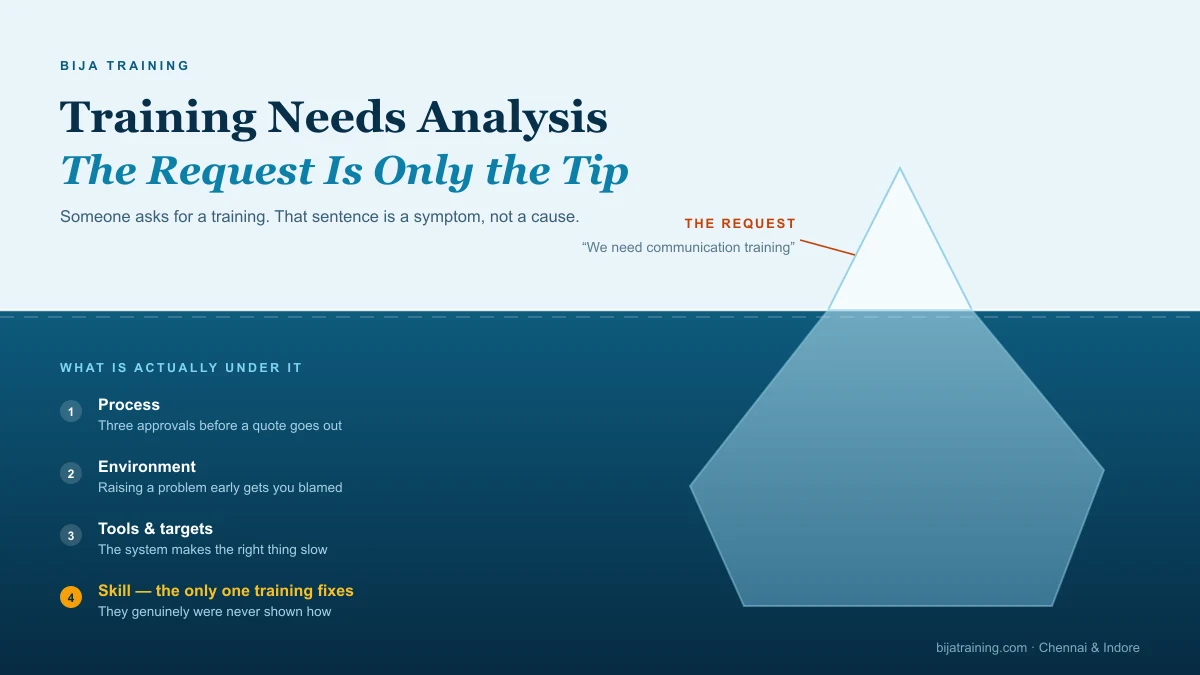
So we asked to see the complaint. It ran to about four lines, and it wasn't about communication at all — the client was annoyed that quotations were taking eleven days. When we traced the process, a quotation needed three separate approvals, and the second approver travelled most of the month.
Two days of communication training would have changed nothing. Twenty-two people would have lost two working days, everyone would have rated it 4.4 out of 5, and quotations would still have taken eleven days.
That is what a training needs analysis is for. Not paperwork before the real work — it is the work. It's the difference between fixing a problem and buying a training day.
What a Training Needs Analysis Actually Is
A training needs analysis is a structured enquiry that establishes the gap between how people perform now and how they need to perform to hit a business goal — and then works out whether training is the right instrument to close it.
Notice the second half. Most people treat a needs analysis as a way of choosing which training to run. It should first answer a blunter question: should we run training at all? A good analysis quite often ends with "no, and here's what to fix instead." That answer saves more money than any negotiation on day rates.
Start With the Business Problem, Not the Training Request
Almost every request arrives already translated into a solution: "we need assertiveness training", "we need a leadership programme", "our middle managers need to be more accountable."
Translate it back. Ask what happened that made this feel necessary. Keep asking until you land on something someone already measures — attrition in a particular grade, rework in a plant, complaints from one account, a project that slipped twice.
If you can't get to a number that already exists somewhere in the business, that is itself a finding. It usually means the request came from a feeling rather than a problem, and it's worth saying so before anyone builds a curriculum around it.
This is also what makes evaluation possible later. If you never named the number at the start, you have nothing to compare against afterwards, which is the main reason measuring training ROI feels impossible in so many organisations.
The Four Places to Look for Evidence
Four sources, and you want all four. Any one of them on its own will mislead you.
Business data
Whatever already gets tracked: attrition by grade and by manager, quality and rework figures, customer complaints by category, cycle times, safety incidents, sales conversion. You're not looking for proof, only for a pattern worth investigating. If attrition is 40% in one department and 8% everywhere else, you have somewhere to point the interviews.
The managers
The single most useful question to ask a manager is: what do you find yourself correcting again and again?
It works because it asks for observed behaviour rather than opinion. "They lack ownership" is an opinion. "I have to ask three times before anyone tells me a delivery date has slipped" is a behaviour — specific, trainable, and measurable.
The people who would attend
Skipping this step is the most common mistake, and it produces programmes that participants can tell were designed without them. Ask where they get stuck, what part of the job nobody explained, and what they'd want a new joiner to be told on day one. That last question gets remarkably honest answers.
You'll also hear things that aren't training problems — a broken tool, an unrealistic target, a manager everyone avoids. Write those down too. They belong in the report.
The work itself
Sit and watch. A morning on a shop floor, a few sales calls, one governance meeting.
This is the step everyone drops for lack of time and it's the one that most often changes the conclusion. In the quotation case above, nobody described the approval workflow as a problem in any interview — it was simply how things had always been done. It only became visible when we followed one quotation end to end.
Skill Gap or System Problem?
Once you have the behaviour gap, you have one question left, and it decides everything.
Could they do it if their life depended on it?
If the honest answer is yes, it is not a skill gap. The cause is somewhere in the system — the process makes it hard, the tool doesn't support it, the workload makes it impossible, the incentives reward something else, or their manager reacts badly when they try. Training cannot fix any of those. It will produce people who now know exactly what they're being prevented from doing, which is worse than not training them, because you've added frustration to the original problem.
If the answer is genuinely no — they've never been shown, never practised, wouldn't know where to start — then it's a skill gap and training is the right response.
In our experience, somewhere near half of what arrives as a training request turns out to be system rather than skill. That is roughly what Robert Mager and Peter Pipe argued back in 1970 in Analyzing Performance Problems, and it has aged well. It's also why generic off-the-shelf training fails so reliably — a stock curriculum can't tell the difference, because it never asked.
A Four-Step Sequence You Can Run in Two Weeks
For a single team or department, this is a two-week exercise, not a quarter-long project.
Step 1 — Name the business problem (2 days)
Meet whoever raised the request. Get to a number that already exists. Write one sentence: we want X to move from A to B by [date]. If you can't write that sentence, stop here and go back.
Step 2 — Find the behaviour gap (5 days)
Interview managers and the people who'd attend. Six to ten conversations is usually enough — answers start repeating faster than people expect. Convert everything into observable behaviour. "Poor communication" becomes "problems are raised in the weekly review rather than the day they appear."
Step 3 — Diagnose the cause (2 days)
Observe the work. Then apply the life-depends-on-it test to each behaviour gap, and sort them into two lists: skill, and system.
Step 4 — Decide, and report both lists (2 days)
Recommend training for the skill list. Hand the system list to whoever owns those processes — plainly, without softening it.
Report both. Presenting only the training half is how the same problem comes back next year with a bigger budget attached.
When Training Isn't the Answer
Some patterns come up often enough to name:
- One team, everyone struggling. Nearly always the manager, the targets, or the process — not twelve simultaneous individual skill gaps.
- People knew how, then stopped. Something changed in the environment. Find that.
- Only new joiners struggle. That's an onboarding design problem — see our note on making freshers work-ready.
- The behaviour is quietly punished. If flagging a delay gets you blamed, no amount of training will make people flag delays.
Saying so costs a trainer revenue in the short term. It's also the only way the next conversation with that client is a real one.
Frequently Asked Questions
What is a training needs analysis?
A structured enquiry that identifies the gap between how people currently perform and how they need to perform to meet a business goal, then determines whether training is the right way to close it. It runs from business problem, to behaviour gap, to diagnosed cause, and only then to a training decision.
How long does a training needs analysis take?
For one team or department, about two weeks: 2 days on business data, 5 days of interviews, 2 days observing the work, 2 days to analyse and report. Organisation-wide, allow four to six weeks. Anything much faster is a survey, not an analysis.
How do you tell a skill gap from a system problem?
Ask whether the person could do it correctly if their life depended on it. If yes, it's not a skill gap — the cause is process, tools, workload, incentives or management, and training won't fix it. If genuinely no, training is appropriate. Roughly half of all training requests turn out to be system problems.
What questions should a training needs analysis ask?
Four: which business number should this move; what do people do today that differs from what's needed; what stops them doing it correctly right now; and what would we see them doing differently in ninety days. Questions about preferred topics come last, if at all.
Should it be done internally or by an external partner?
Internal teams gather data faster and know the context. External facilitators get more candid interviews, because people will describe a manager or process problem to someone outside the appraisal system. Many organisations split it: internal data collection, external interviews.
Where to Start
Next time a training request lands on your desk, don't ask what topic they want. Ask what happened.
Then follow it back until you reach something someone already measures. You'll either find a real skill gap worth training — or you'll find the eleven-day quotation, and save everyone two days and a proposal.
We run training needs analyses as standalone work, whether or not the answer turns out to be training. Talk to us about your situation, or read more about how we build customised in-house programmes and leadership development around what the analysis finds.