A manufacturing client promoted their best process engineer to lead her own team of six. Obvious choice — she was the person everyone already went to.
Seven months later they asked us to coach her. The team's output was down. Two people had asked for transfers. And she was working till nine most evenings, because she had quietly taken back most of the work she'd delegated. Every one of those decisions had felt reasonable at the time.
Nobody had trained her. She'd been promoted in March and handed a team, and the company's assumption — a very common one — was that someone that good at the work would work out how to manage it.
First-time manager training exists because that assumption is wrong, and expensively so.
Why the Promotion Breaks People
The promotion inverts what you're measured on.
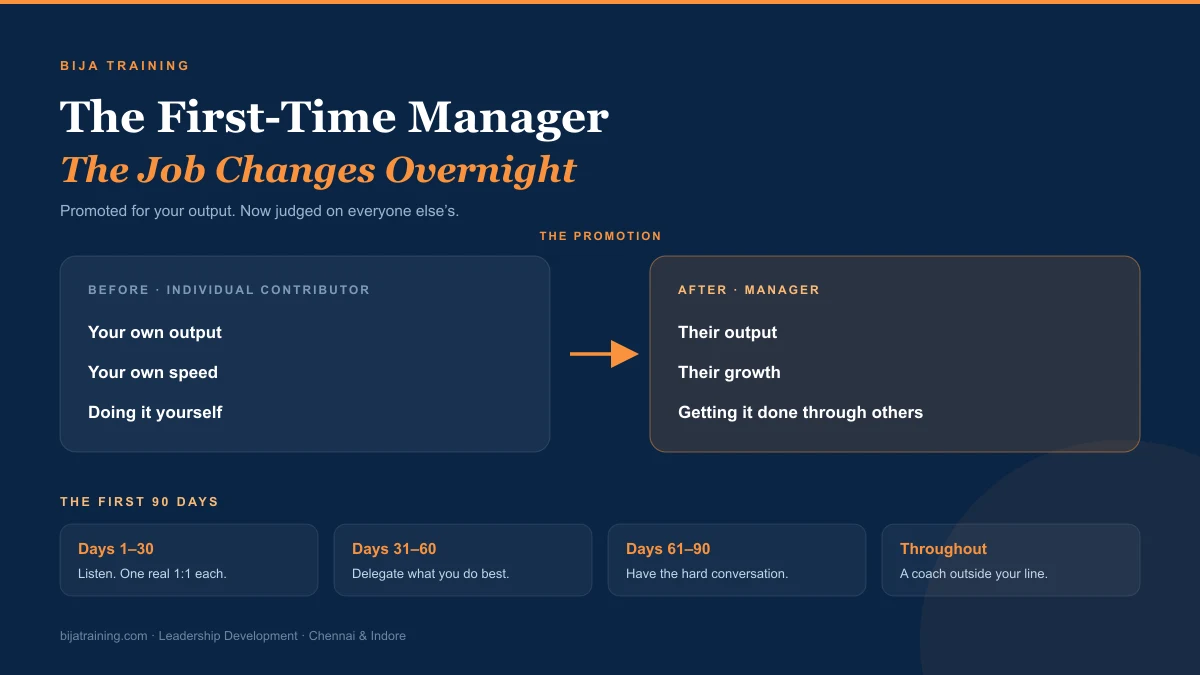
For years, your value was what you personally produced. You got good at it, and you were promoted because you got good at it. Then on a Monday morning your output stops mattering and you're judged on six other people's, using a completely different skill set that nobody has ever assessed you on.
It isn't a step up the same ladder. It's a different ladder, and the qualities that got you here — speed, personal ownership, doing it properly yourself — actively work against you now.
The consequences are not small. Gallup's research on management has consistently found that the manager accounts for the large majority of the variance in a team's engagement — roughly 70%. Promoting someone into that role and leaving them to work it out is an unusual thing to do with a lever that large.
The Four Things That Break First
They keep doing the work themselves. The most common and the most understandable. Explaining a task takes forty minutes; doing it takes fifteen. Under pressure, the new manager does it. And the arithmetic is genuinely correct — for that one task, this week. Repeated for three months, they've built a team that waits for instructions and a manager with no time to manage.
They avoid the difficult conversation. Somebody is underperforming, or turning up late, or upsetting a colleague. The new manager knows, and hopes it will resolve itself. It doesn't. It becomes an appraisal-day ambush six months later, which is worse for everyone, and by then the rest of the team has drawn its own conclusions about what the standards actually are.
They never renegotiate with former peers. Yesterday you complained about management together; today you are management. Everyone can feel the change and nobody names it, so both sides guess. The new manager over-corrects into formality, or under-corrects into pretending nothing happened. Both go badly.
They optimise for being liked. Understandable, and it works for about eight weeks. Then a decision has to be made that someone won't like, and a manager who's spent two months avoiding friction has no foundation to make it from. Being trusted and being liked overlap, but they are not the same thing, and only one of them is the job.
What Most Companies Do Instead
Two patterns, both poor.
The first is nothing. The promotion is announced, and support consists of "let me know if you need anything" — an offer no new manager will take up, because taking it up means admitting they're struggling in a role they were just given.
The second is a two-day leadership programme, six to nine months in. By then the habits are set. They've spent three quarters doing the team's work, avoiding one particular conversation, and being everybody's friend. The content is fine and it arrives long after it would have been useful. That's a timing failure, not a content failure — the same one we describe in why training doesn't stick.
A 90-Day Plan for a New Manager
This is deliberately small. Three things in three months. New managers are overwhelmed and a long list gets ignored.
Days 1–30: Listen
One proper one-to-one with every team member. Not a status update — thirty minutes, three questions, and mostly listening.
What's working well in how this team runs? What's frustrating that we could actually change? What do you want to be doing more of in a year?
Don't fix anything in the first month, beyond the obviously broken. The temptation to arrive with improvements is strong and it costs you the information you'd have got by waiting.
If any of the team are former peers, have the awkward conversation explicitly and early. Something like: this is odd for both of us; here's how I'm planning to handle decisions; tell me if I get it wrong. Two minutes, and it removes a month of guessing.
Days 31–60: Hand over work you're good at
Not the tasks you dislike — those are easy to give away and prove nothing. Delegate something you're genuinely proud of doing well.
Then let it be done differently. It will be slower the first time and it will not be done your way. Resist taking it back; that's the entire exercise. A manager who only delegates what they don't want has not delegated, they've dumped.
The skill underneath this is teaching rather than doing, which is closer to coaching than to instruction — we've written about the difference between mentoring and coaching and where each fits.
Days 61–90: Have the conversation you're avoiding
By now you know which one it is. Every new manager has one.
Have it before day 90. Prepare it properly: what you observed, factually; what the impact was; what needs to change; what you'll do to help. Twenty minutes of preparation makes the difference between a conversation and an argument.
It will go better than you expect. They almost always do — the dread is worse than the event, and the team notices that standards are real.
Throughout: someone outside the reporting line
A new manager cannot take their manager problems to their own manager without it feeling like an admission. They need a coach or mentor outside that line — internal or external — for one honest conversation a month.
It's the cheapest part of the whole thing and the part people most often skip. If you're running a broader programme, this is where coaching earns its cost most clearly, because the questions a new manager needs to ask are ones they can't ask upwards.
What the Organisation Has to Do
The new manager can't fix all of this alone.
Reduce their individual workload — genuinely, in writing. A "player-coach" who still carries a full personal target will do the individual work, because that's what's measured. If you don't change the measurement, you haven't changed the job.
Tell them what good looks like in this role, specifically. Most new managers have never seen their own role described in behavioural terms, only in outcomes.
And promote earlier than the promotion. Give people small pieces of the job — running a review, mentoring a junior, owning one deliverable end to end — six months before the title. It's the same logic behind a structured campus-to-corporate programme: exposure before the deep end.
Frequently Asked Questions
What is first-time manager training?
Preparation for the shift from doing the work to being accountable for others doing it — delegation, one-to-ones, difficult feedback, and renegotiating relationships with former peers. It's behavioural, not technical, because the skills that earned the promotion aren't the ones the role needs.
When should a first-time manager be trained?
Within the first month of promotion, not six months later. Habits set early — a manager who spends ninety days doing the team's work has already established that with the team, and unwinding it is much harder than preventing it.
Why do good employees fail as first-time managers?
The promotion rewards one skill set and requires another. Four things break first: they keep doing the work themselves because it's faster, they avoid difficult conversations, they never renegotiate with former peers, and they optimise for being liked rather than trusted.
What should a new manager do in the first 90 days?
Days 1–30: one honest one-to-one with every team member, mostly listening. Days 31–60: delegate something you're good at, and let it be done differently. Days 61–90: have the difficult conversation you've been postponing. Throughout: work with a coach outside your reporting line.
How is managing former peers different?
The relationship has changed and nobody has said so, which leaves both sides guessing. The fix is a short, direct conversation in the first month: acknowledge it's awkward, say how decisions will now be made, ask what they need. Avoiding it doesn't make it less present.
Where to Start
If you've promoted someone in the last three months, ask them one question this week: what's the thing you're currently doing yourself that you should have handed over?
They'll know the answer immediately. Whether they can act on it depends largely on whether their own workload was ever adjusted — which is your part of this, not theirs.
We run first-time manager programmes built around the first 90 days — spaced sessions, real conversations, and coaching support outside the reporting line. Talk to us about your new managers, or read more about our leadership development approach.