Here is a test worth running on your own organisation. Ask five managers to describe the last piece of critical feedback they gave. Then ask them what changed afterwards.
Most will answer the first question in detail — they remember preparing, they remember the wording, they remember that it went reasonably well. Very few can answer the second at all.
That gap is the whole problem. We have trained a generation of managers in how to give constructive feedback comfortably, and almost none in how to give feedback that changes anything. These are not the same skill, and the popular frameworks mostly teach the first.
Key Takeaways
- The sandwich method and, to a lesser degree, SBI optimise for the giver's comfort — they end where the hard part begins.
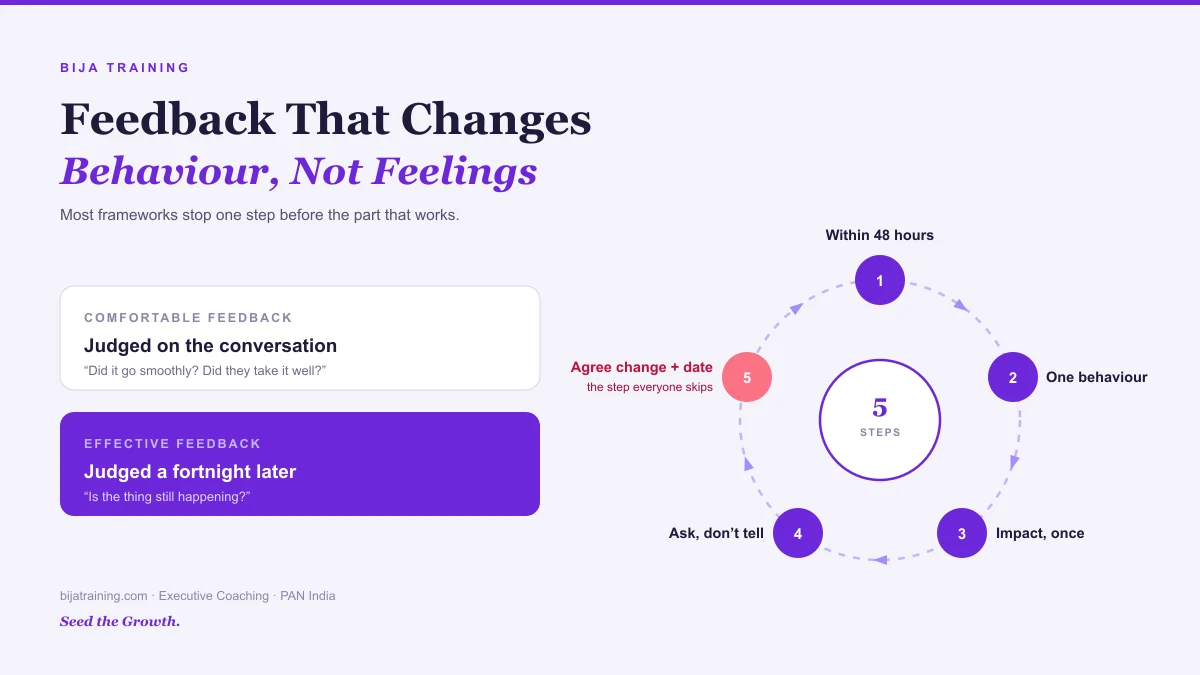
- Comfortable feedback is judged by how the conversation felt. Effective feedback is judged by what happens in the next fortnight.
- A workable framework ends in a specific commitment and a named check-in date.
- Timing beats wording. Feedback within 48 hours, imperfectly phrased, outperforms a polished version a month later.
- Without follow-through, even a well-delivered conversation reads as something the manager needed to say rather than something you need to do.
Why Most Feedback Frameworks Optimise for Comfort
The sandwich method — praise, criticism, praise — is the most widely taught and the least defensible. Its purpose is to make delivery easier for the manager, and it does. It also reliably destroys the message.
Everyone recognises the structure within about two exposures. After that, the opening compliment becomes a warning signal rather than encouragement, and the actual point gets filed as the awkward bit in the middle that both parties are keen to move past. The receiver often leaves genuinely unsure whether they were criticised at all — which is exactly why managers like it.
SBI — Situation, Behaviour, Impact, developed by the Center for Creative Leadership — is a substantial improvement and we still teach it. Anchoring to a specific situation and an observable behaviour removes most of the defensiveness that vague character feedback generates.
But notice where SBI stops. It is a framework for describing something accurately. It has nothing to say about what happens next, and "what happens next" is the only part that determines whether behaviour changes. A manager can execute SBI flawlessly and produce no change whatsoever, because the conversation ended at impact and everyone went back to work.
Comfortable Feedback vs Effective Feedback
The distinction is easiest to see in how you would judge success.
Comfortable feedback is evaluated on the conversation. Did it go smoothly? Did they take it well? Was the relationship preserved? These are the questions managers actually ask themselves afterwards, and by these criteria a conversation where nothing was really said scores extremely well.
Effective feedback is evaluated a fortnight later, on behaviour. Is the thing still happening? That question is uncomfortable precisely because it can be answered, and often the answer is yes.
Effective feedback is usually a slightly worse conversation and a substantially better outcome. It involves a pause that lasts too long, some visible discomfort, and a specific commitment the receiver would rather not have made. Managers optimising for a pleasant thirty minutes will avoid all three.
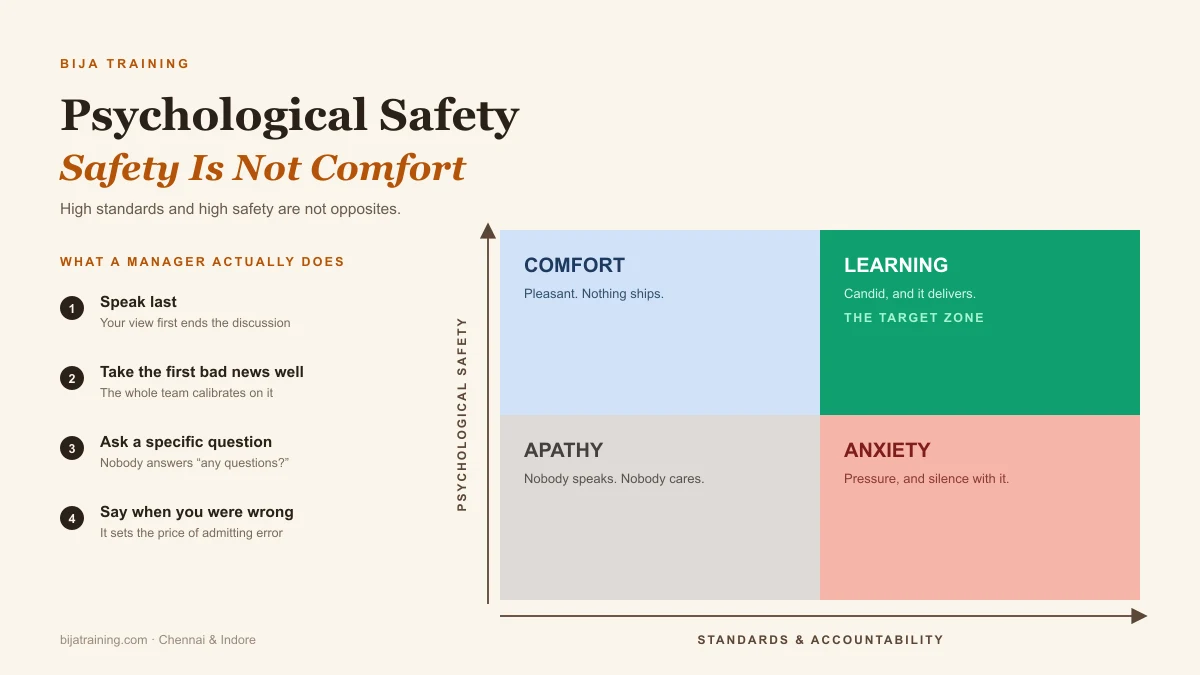
Worth saying plainly: none of this works in a team where raising problems is punished. If people are defensive because candour has historically been expensive, no framework will rescue the conversation — that is a psychological safety problem and it has to be fixed first.
A Framework That Ends in a Commitment
Five steps. The first four are recognisable; the fifth is the one that does the work.
1. Say it within 48 hours
Not at the appraisal. Not at the next scheduled one-to-one if that is three weeks out. Within two days, while both of you can still recall the specifics.
Feedback saved up for a formal moment arrives as a verdict on a period rather than a response to an event, and a verdict invites a defence.
2. One thing, described as behaviour
One. Not three, not the list you have been accumulating. People can act on one change at a time and shut down in the face of four.
Describe what was observable. "You interrupted Priya twice in the client review" is a fact that can be discussed. "You can be dismissive in meetings" is a character judgement that can only be denied.
3. Name the impact once, then stop
Say what the consequence was — for the client, the project, the team member. Once, plainly, and then be quiet.
The commonest error is repeating the impact in three different ways because the silence is uncomfortable. That converts a piece of feedback into a telling-off, and the receiver stops processing and starts defending.
4. Ask, don't prescribe
"How do you see it?" before "here is what I need you to do."
Partly because you may be missing context. Mostly because a solution someone arrives at themselves survives contact with a busy Tuesday, and one they were handed does not. If they land somewhere reasonable, take it even if your version was better.
5. Agree what changes — and when you will check
This is the step almost everyone omits, and without it the previous four are a well-conducted chat.
End with two specifics: what will be different, and when you will both look at it again. "In Thursday's review you will bring the cost breakdown before the recommendation, and we will see how it landed at our one-to-one on the 30th."
Then put the date in your calendar in front of them. That single gesture communicates more than anything you have said in the preceding twenty minutes — it establishes that this was a change request, not a complaint.
Why Timing Beats Wording
Managers who avoid feedback almost always describe the obstacle as wording. They are waiting to find the right way to say it.
The wording matters far less than they think. Rough, specific, kind feedback on Wednesday about Tuesday beats an elegantly constructed version delivered four weeks later — because the delay itself carries a message. It says the issue was not urgent enough to raise, which quietly contradicts everything you are about to say about its importance.
Delay also compounds. The behaviour continues, each repetition making it harder to raise, until the accumulated frustration means it finally comes out with more force than the original incident ever warranted. The receiver experiences an overreaction to a small thing, and they are not wrong.
Follow-Through Is the Whole Thing
If you agree a check-in and then never mention it again, you have taught something quite precise: this was a conversation the manager needed to have, not a change the organisation required.
People read that accurately and behave accordingly. It is also why the third or fourth round of feedback from a manager who never follows up gets visibly less attention than the first.
The follow-up itself takes about four minutes. Did it change, was it easier or harder than expected, what got in the way. When it has gone well, say so specifically — that is the moment the new behaviour becomes something the person owns rather than something they are complying with.
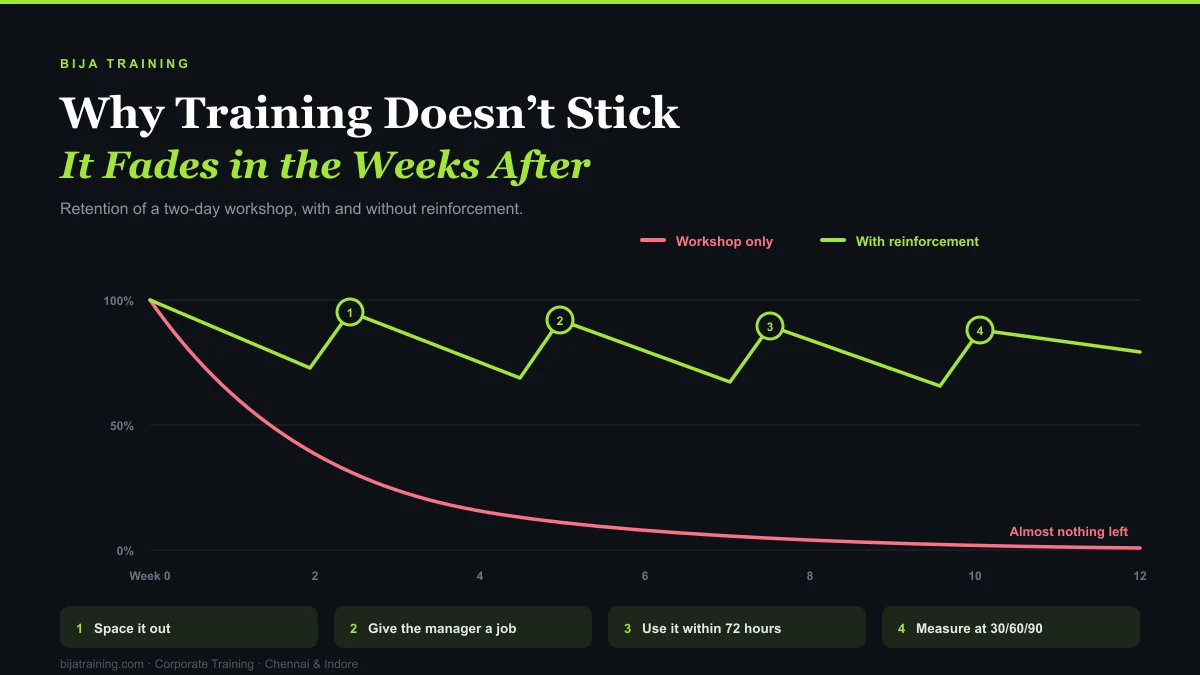
This is the same reinforcement logic that governs whether any development sticks at all, which we go into in why training doesn't stick. Feedback is simply the smallest possible unit of the same problem.
Frequently Asked Questions
What is the most effective feedback framework?
One that ends in a commitment. Deliver within 48 hours, raise one behaviour described observably, state the impact once, ask for their view before prescribing, then agree specifically what will change and when you will both review it. The final step is what separates feedback that changes behaviour from feedback that is merely well-delivered.
Why doesn't the feedback sandwich work?
Because people recognise the structure quickly, after which the opening praise reads as a warning and the substantive point is filed as the uncomfortable middle. It reliably leaves the receiver unclear about whether they were criticised — which is precisely why managers find it comfortable to use.
How soon should you give feedback?
Within 48 hours. Specific, slightly clumsy feedback given promptly outperforms a polished version weeks later, because delay signals the issue was not important and lets frustration accumulate until the eventual delivery is disproportionate.
Is SBI a good feedback model?
Yes, as far as it goes. Situation-Behaviour-Impact is a genuine improvement on vague character feedback and removes most defensiveness. Its limitation is that it stops at description — it says nothing about agreeing a change or following up, which is where behaviour is actually determined.
How do you follow up on feedback?
Schedule the check-in during the original conversation and put it in the calendar while the person is present. At the check-in, take four minutes: has it changed, was it easier or harder than expected, what got in the way. Acknowledge specific improvement out loud — that is what converts compliance into ownership.
Where to Start
Take the last piece of feedback you gave. Ask yourself one question: did it end with an agreed change and a date?
If not — and for most managers it will not have — that is the single adjustment worth making. Everything else in this article is refinement. The commitment and the date are the mechanism.
Our coaching and behavioural programmes work on real conversations managers are currently avoiding, with practice and follow-up built in. Talk to us about your team, or see how we run executive coaching for leaders across India.