An HR director put the objection to me more bluntly than most: "Half my team is in Pune, a third is in Bengaluru, and four people are fully remote. You want me to fly everyone somewhere to do a rope activity?"
It is a fair challenge and it deserves a straight answer rather than a brochure. So: yes, team building for hybrid teams still works — but not in the format most companies buy, and not for the reason most companies think they are buying it.
The honest version is that hybrid working has made outbound training more valuable and considerably harder to justify. Both things are true at once.
Key Takeaways
- Outbound training does not work because it is fun. It works because shared difficulty produces trust that meetings cannot.
- Hybrid teams lose the informal, unplanned contact where trust normally accumulates — which raises the value of deliberate in-person time.
- Some things genuinely do not transfer to video: physical shared risk, unstructured recovery time, and reading a room.
- The model that works is a quarterly in-person anchor plus short virtual reinforcement between — not an annual offsite.
- One well-designed day beats three days of activities. The debrief is the product; the activity is just what generates material for it.
The Objection, Stated Fairly
The objection is not really about outbound training. It is about cost per unit of benefit, and under hybrid the cost side got much worse.
When everyone sat in one office, an offsite meant a bus. Now it means flights from four cities, hotel rooms, two days of everyone's calendar, and the awkward question of whether the fully-remote colleague in Coimbatore is expected to travel for a team-building exercise.
Meanwhile the benefit was always the hardest thing to evidence. So the honest position for any provider is: the bar is higher now, and a lot of what gets sold as outbound training does not clear it.
What Outbound Training Actually Builds
The reason the objection lands so easily is that the category has spent twenty years marketing itself on the wrong thing. Photographs of people laughing on a raft suggest the product is enjoyment, and enjoyment is obviously not worth four flights.
What well-run outbound training actually produces is narrower and more useful.
Trust built through shared difficulty. People come to trust colleagues they have struggled alongside in a way that is very hard to manufacture in a conference room. It is not the success that does it — it is having been visibly out of your depth in front of each other and handled it.
Seeing people outside their role. In the office, the quiet analyst is the quiet analyst. Put a group in an unfamiliar situation with no org chart and the distribution of who contributes changes, sometimes dramatically. That recalibration persists afterwards, and it is often the single most valuable output.
A shared reference point. Teams that have been through something together acquire shorthand. Six months later someone says "this is the second river crossing" and everyone knows what is meant. That kind of compression is genuinely useful under pressure.
Accelerated group formation. A team working through the usual stages of group development will get through the awkward early phase eventually. Structured shared challenge compresses months into days — which matters most for newly formed or newly merged teams.
We unpack the mechanism in more detail in why outbound training builds what classrooms can't. The short version: it is about shared risk, not recreation.
What Hybrid Genuinely Breaks
Here is the part that strengthens the case rather than weakening it.
In a co-located team, trust accumulates without anyone planning it — the walk to the canteen, the five minutes before a meeting starts, overhearing how a colleague handles a difficult call. None of that is scheduled and all of it matters.
Hybrid removes nearly all of it. What remains is scheduled, agenda-bound contact, which is efficient and almost useless for building relationships. The result is teams that coordinate well and know each other barely at all — fine while things go smoothly, fragile the moment there is a disagreement or a crisis.
So the informal channel that used to build trust for free has closed. Which means the only remaining option is to do it deliberately — and deliberate trust-building is precisely what outbound training is.
What Doesn't Transfer to Video
Virtual team building has a real role, and it is worth being clear about its ceiling.
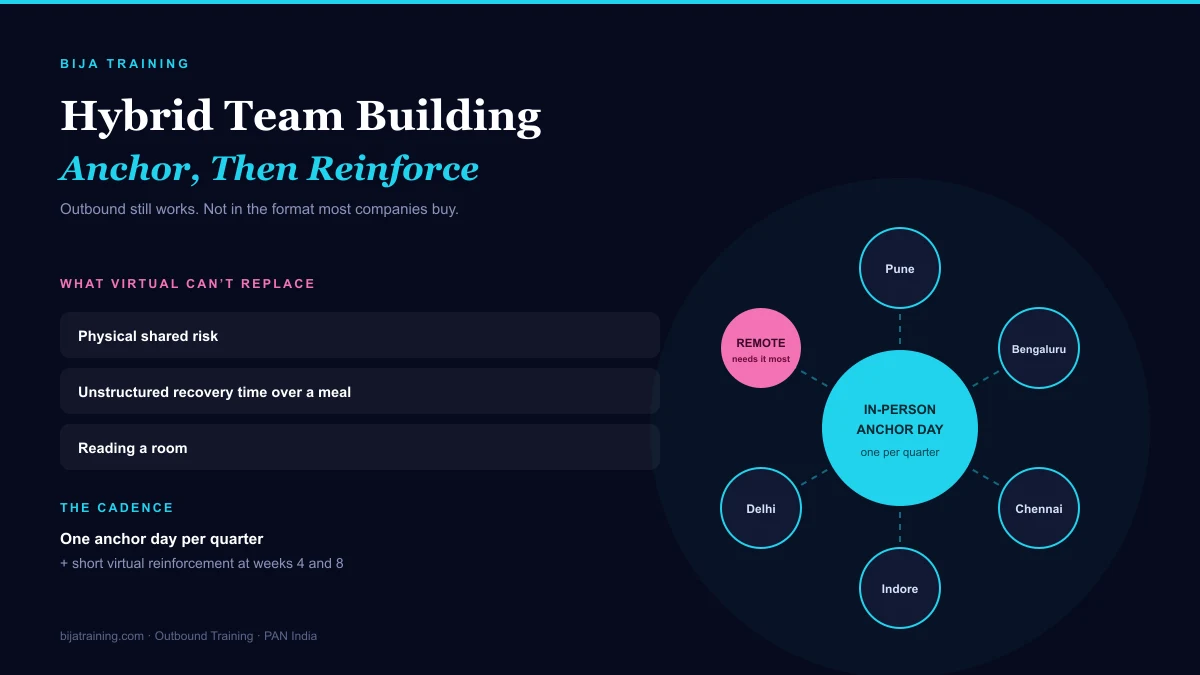
Three things do not survive the transition. Physical shared risk — the specific bond of having been slightly out of your depth together has no video equivalent, and online escape rooms do not produce it. Unstructured recovery time — the conversations after the activity, over a meal, are where most of the actual relationship-building happens, and a video call has no equivalent of the twenty minutes where nobody is running anything. Reading a room — noticing that someone has gone quiet, spotting the glance between two colleagues. Gallery view removes almost all of this.
What virtual does well is maintenance and reinforcement. It is good at keeping a relationship warm and poor at starting one. Which points directly at the model.
A Hybrid Model That Works
Stop thinking about the annual offsite. Think about an anchor-and-reinforce rhythm across the year.
The quarterly anchor
One in-person day per quarter, everyone physically present. One day, not three — this is the change most organisations resist and most benefit from.
Three days exists because travel made shorter events uneconomic, and it filled the time with activities rather than value. A single well-designed day, with two or three substantial challenges and long, properly facilitated debriefs, produces more than three days of continuous activity. The activity is only raw material; the debrief is the product.
Rotating the location between your main city hubs also distributes the travel burden rather than concentrating it on whichever group is furthest from head office.
The reinforcement between
Short virtual sessions at roughly four and eight weeks after the anchor. Thirty to forty-five minutes, small groups, and explicitly about the anchor rather than new content.
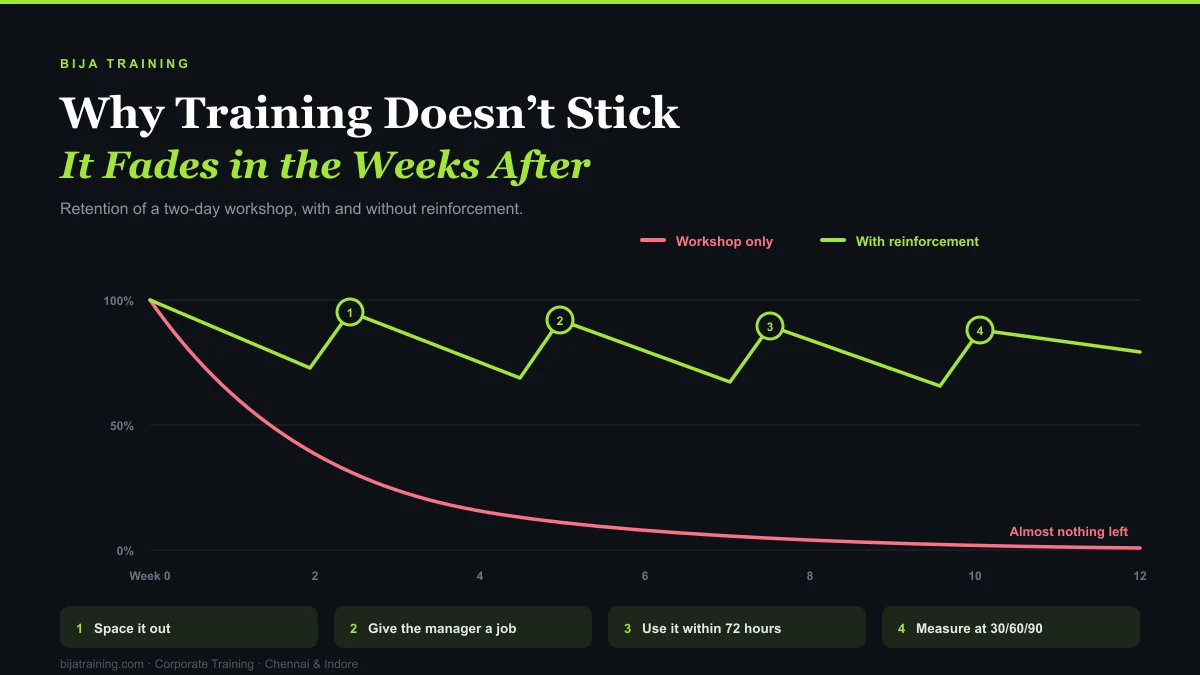
What did you try? Where did the old pattern come back? What is still difficult? This is the same spacing logic that governs whether any development survives contact with normal work — the reasoning is in why training doesn't stick.
Without these, the anchor day is an event people remember fondly. With them, it is a programme.
Who actually has to be there
Everyone, including the fully-remote colleague in another state. Especially them.
Remote team members are the ones carrying the largest trust deficit, because they get the least informal contact. Excluding them from the one occasion designed to fix that — on cost grounds — inverts the logic entirely. If budget forces a choice, fly in the remote people and let the co-located group travel less.
When Not to Do This
Worth saying, because it disqualifies a fair number of enquiries.
If the team's problem is a manager nobody trusts, an unworkable process, or a target everyone privately knows is impossible, outbound training will not touch it. It may make things worse — a day of enforced togetherness with an unaddressed grievance in the room usually surfaces the grievance without resolving it.
If your team is stable, long-tenured and already works well together, quarterly is too often. Once or twice a year is plenty.
Quarterly anchoring earns its cost for newly formed teams, recently merged ones, teams that have grown quickly through remote hiring, and groups where cross-location friction is already visible. If none of that describes you, we would say so.
Frequently Asked Questions
Does outbound training work for hybrid teams?
Yes, and hybrid arguably increases its value — because the informal contact that used to build trust for free has largely disappeared. What changes is the format: shorter, more frequent in-person anchors with virtual reinforcement between, rather than one long annual offsite.
What does outbound training actually achieve?
Four things: trust built through shared difficulty, seeing colleagues perform outside their formal role, a shared reference point the team can use as shorthand later, and faster progress through the early awkward stages of group formation. Enjoyment is a by-product, not the mechanism.
Can team building be done virtually instead?
Partly. Virtual works well for maintaining existing relationships and reinforcing earlier in-person work. It cannot replicate physical shared risk, unstructured recovery time over a meal, or the ability to read a room — which is why it functions best as reinforcement rather than as a substitute.
How often should hybrid teams meet in person?
For newly formed, recently merged or fast-growing distributed teams, a single well-designed day each quarter with short virtual reinforcement at four and eight weeks works well. Stable, long-tenured teams generally need only one or two in-person events a year.
Should fully remote employees travel for team building?
Yes — they benefit most, because they carry the largest trust deficit from the least informal contact. If budget is constrained, prioritise bringing remote colleagues in over moving the co-located majority around.
Where to Start
Ask your distributed team one question: how many people on this team have you never had a conversation with that wasn't about work?
In most hybrid teams of twenty or more the answer is uncomfortable, and it maps almost exactly onto where things go wrong when a project comes under pressure. That map is your design brief — not the activity catalogue.
We design hybrid programmes around in-person anchor days with virtual reinforcement between, and run them at venues across India so travel doesn't fall on one location. Tell us how your team is distributed, or see our outbound training approach.