A software firm we work with used to screen candidates on a single aptitude test. Top two per cent or no interview. It produced, by any technical measure, an outstanding engineering group.
It also produced two team leads who between them lost nine engineers in eighteen months. Both were, genuinely, the smartest people in the building. Neither could tell when someone had stopped speaking up in their meetings.
That gap has a name, and it is the most reliable predictor of whether a clever person will be any good at running a team. Emotional intelligence at work is not a soft alternative to competence. It is the thing that decides whether competence survives contact with other people.
Key Takeaways
- Technical hiring optimises for IQ, but retention and team performance track EQ — and almost nobody screens for it.
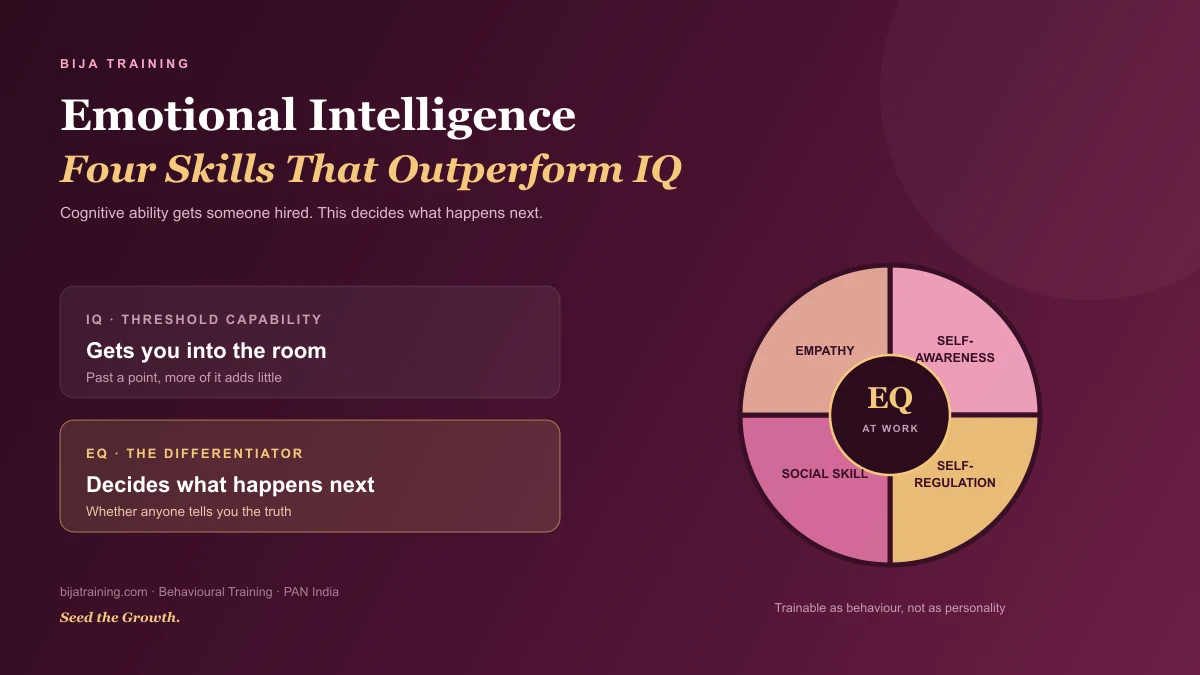
- The four competencies that matter at work are self-awareness, self-regulation, empathy and social skill.
- Low-EQ management shows up early: silent meetings, surprise resignations, and feedback that only arrives at appraisal.
- EQ is trainable as behaviour, not as personality. Target specific habits, not a mindset shift.
- Build it into manager training with observation, spaced practice and a coach — not a one-day workshop.
Why IQ Gets You Hired and EQ Decides What Happens Next
Every selection process in Indian corporate hiring is tuned to measure raw cognitive ability. Aptitude tests, case rounds, coding screens, CAT percentiles. These work — they genuinely predict whether someone can do the technical job.
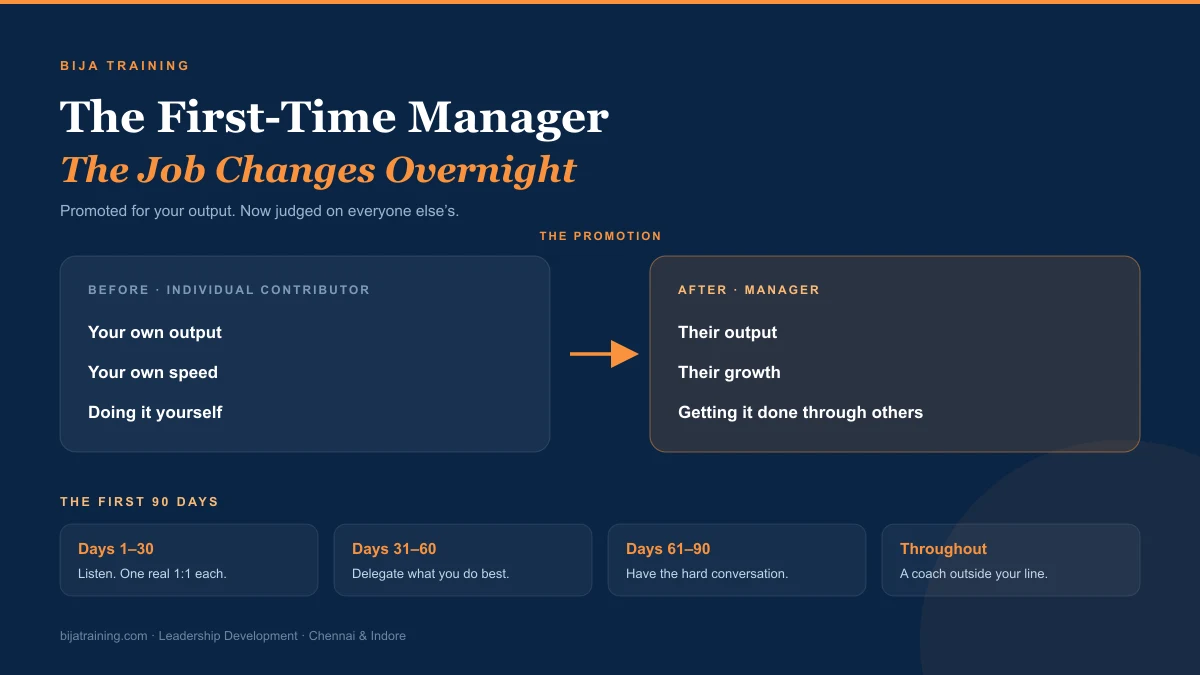
The trouble starts at promotion. We take the strongest individual performer and make them responsible for a team, which is a different job requiring a different set of skills. We covered the mechanics of that failure in our piece on what breaks in a first-time manager's first 90 days. Emotional intelligence is the underlying capability beneath most of it.
Daniel Goleman's argument in What Makes a Leader was that cognitive ability and technical skill are threshold capabilities — they get you into the role, and above a certain point more of them adds little. What separates effective leaders from merely clever ones sits elsewhere. Thirty years on, that framing has held up better than most management theory.
The Four Competencies That Actually Matter
Goleman's original model has five components. In practice, four of them do most of the work in a corporate setting. The fifth — intrinsic motivation — matters enormously but is much harder to build through training, so we treat it as something to hire for rather than develop.
Self-awareness
Knowing what you are actually like to work for. Not what you intend to be like — what you are.
This is the foundation, and it is the one most senior people quietly fail. A manager who believes they are approachable, in a team that has learned they are not, will misread every silence as agreement. Everything downstream depends on getting this right, because you cannot regulate a reaction you do not notice yourself having.
The practical test: can the person name, without prompting, two situations that reliably make them a worse manager? Most cannot. The ones who can are usually the ones worth investing in.
Self-regulation
The gap between feeling something and acting on it.
Nobody is asking managers not to be frustrated. The competency is the pause — the ability to receive bad news at 6pm on a Friday and not let the first ten seconds of reaction set the team's behaviour for the next year. Those ten seconds are worth more than any amount of stated open-door policy.
This is also the most visibly trainable of the four, because it is a habit rather than a trait. People can learn to buy themselves a beat.
Empathy
Worth being precise here, because the word invites eye-rolling in a business context. Empathy at work is not sympathy and it is not agreement. It is the accuracy with which you can predict how a decision will land on the person receiving it.
That is a practical, commercial skill. A manager who can anticipate that a restructure announcement will read as a demotion to three specific people can address it before it becomes three resignations. A manager who cannot will be genuinely surprised, every time, and will describe their team as oversensitive.
Social skill
The ability to get things done through people who do not report to you — which, in most matrixed Indian organisations, is the majority of the work.
Cross-functional influence, managing upwards, building the relationships you will need six months before you need them. This one correlates most directly with whether someone makes it past middle management, and it is almost never on a job description.
How to Spot Low-EQ Management Before It Costs You a Team
You rarely get a clean signal. What you get is a pattern, and it is visible well before the resignations start.
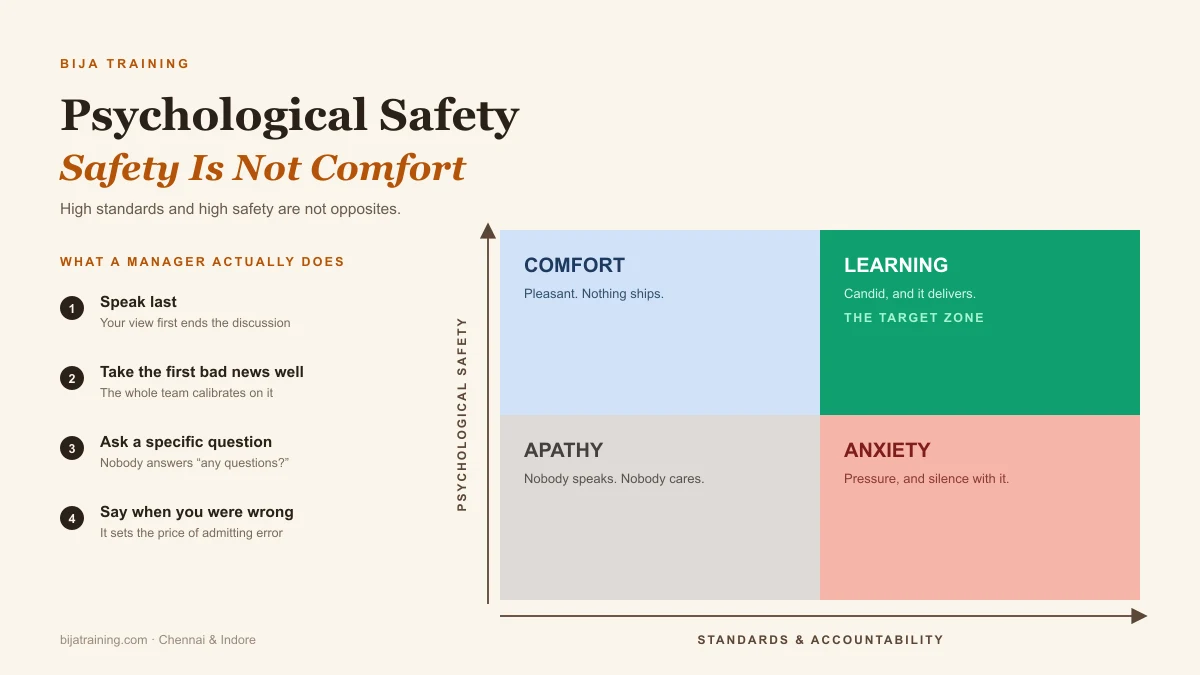
- Their meetings are quiet. Not calm — quiet. One person talks, everyone else updates. Nobody argues.
- Resignations arrive as surprises. If a manager is consistently blindsided by people leaving, they were not reading the signals that were there for months.
- Feedback only happens at appraisal. Difficult conversations get batched into a formal process because the manager finds them uncomfortable in real time.
- Their team's exit interviews sound similar. One departure is a person. Four with the same theme is a manager.
- They describe problems as other people's personalities. "The team is not proactive" is almost always a statement about the environment, not the people.
That first signal is the earliest and the cheapest to act on. It is also the one most organisations misread as a well-run meeting — a point we go into properly in our article on psychological safety at work.
Can Emotional Intelligence Actually Be Trained?
Partly, and it matters to be honest about which parts.
You cannot run a two-day workshop and make a fundamentally incurious person interested in how their team is doing. Dispositional traits are stubborn, and any provider claiming otherwise is selling something.
What you can reliably change is behaviour. A manager can learn to ask a specific question instead of "any questions". They can learn to wait ten seconds. They can learn to run a monthly one-to-one that is not a status update. None of that requires becoming a different person — it requires a handful of concrete habits, practised until they stop feeling artificial.
This distinction is the whole game. Programmes that aim at mindset produce pleasant workshops and no change. Programmes that aim at four or five observable behaviours produce measurable differences in team retention within two quarters.
Building EQ Into Manager Training
A design that works, in the order it should happen:
Start with data, not content. Some form of upward feedback or 360 before anything is designed. Self-awareness cannot be delivered as a slide; it arrives when a manager reads something about themselves they did not expect. That moment is the actual start of the programme.
Pick three behaviours, not twelve. Choose the ones that matter for your context. For most organisations: how they run one-to-ones, how they react to bad news, and how they give feedback between appraisals.
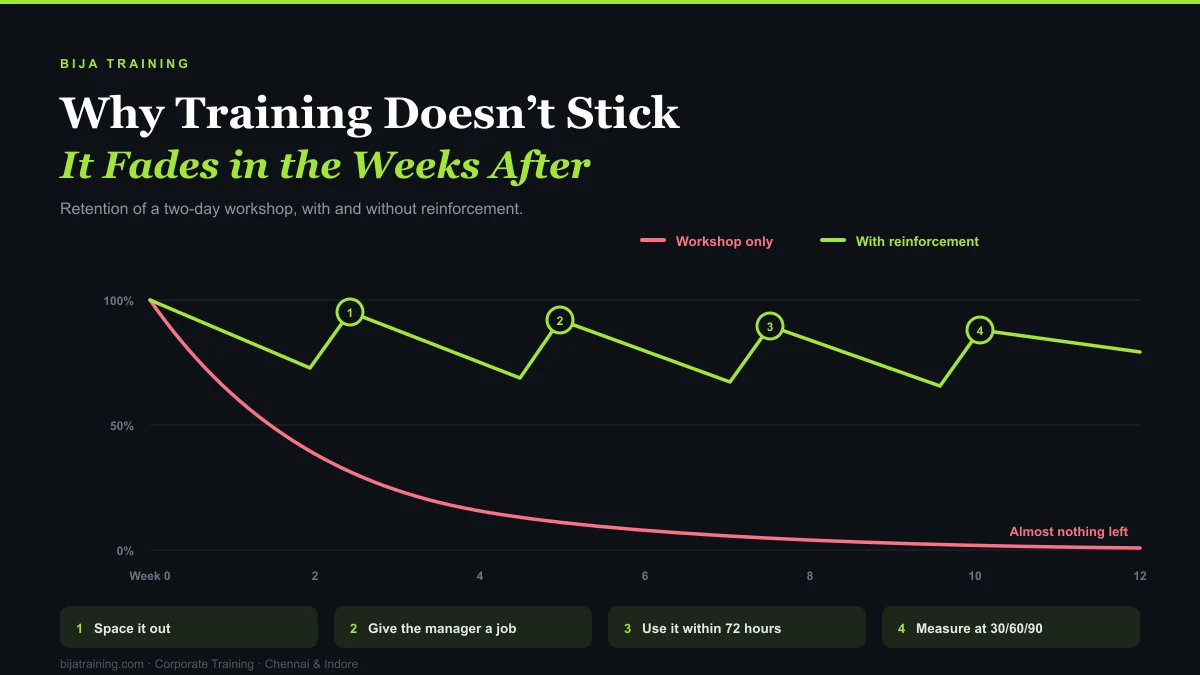
Space it out and make them practise on real work. EQ behaviours only reveal themselves under load. Four half-days across six weeks, with something to try between each, beats a two-day intensive every time — the reasoning behind that is in our piece on why training doesn't stick.
Give them somewhere safe to be honest. A manager cannot tell their own boss that they froze in a difficult conversation. A coach outside the reporting line is where the real work happens.
Measure behaviour, not sentiment. Re-run the upward feedback at six months. Track voluntary attrition by manager. Those two numbers will tell you more than any feedback form.
Frequently Asked Questions
What is emotional intelligence at work?
The ability to recognise and manage your own emotional reactions, and to read and respond accurately to other people's, in a way that improves working relationships and results. At work it shows up as four competencies: self-awareness, self-regulation, empathy and social skill.
Is EQ more important than IQ for managers?
They do different jobs. Cognitive ability is a threshold capability — it gets someone into the role, and beyond a point more of it adds little. Once people are managing others, differences in outcome track EQ far more closely than differences in IQ.
Can emotional intelligence be taught?
Behaviours can, reliably. Dispositional traits mostly cannot. Target specific observable habits — how a manager opens a one-to-one, how they react to bad news, how they ask a question — rather than attempting a mindset shift, and change is measurable within two quarters.
How do you measure EQ in managers?
Upward or 360-degree feedback repeated at six-month intervals is the most practical instrument, read alongside voluntary attrition by manager and exit-interview themes. Self-report EQ questionnaires are weak on their own, because low self-awareness distorts the result.
What are the warning signs of a low-EQ manager?
Meetings where nobody disagrees, resignations that arrive as surprises, feedback batched into the appraisal cycle, repeated exit-interview themes from the same team, and a habit of describing team problems as individual personality flaws.
Where to Start
Pick your five largest teams and put voluntary attrition against each manager's name for the last two years.
The number will not tell you the cause, and it would be unfair to treat it as a verdict. But it will point you at the one or two conversations worth having — and those conversations are usually about EQ, not capability.
Our behavioural programmes work on observable manager habits rather than personality theory, with upward feedback before and after so you can see what moved. Talk to us about your management layer, or read how we structure in-house behavioural training across India.