Most finance teams can tell you, to the rupee, what a laptop costs. Depreciation schedule, replacement cycle, the lot.
Ask the same team what one badly-run team costs the business each year and you will get a pause, then an estimate, then a caveat. It is not incompetence. It is that the cost of bad management never arrives as an invoice. It arrives as a resignation, a slipped quarter, a quiet drop in output — each booked somewhere else, none of it ever added up.
This piece is an attempt to add it up. Not precisely, because precision here would be dishonest. But closely enough that it stops being invisible.
Key Takeaways
- The cost of untrained managers is real and large, but it is distributed across four budgets — so nobody owns it.
- The four buckets: replacement cost, the productivity gap around every exit, disengagement in the people who stay, and senior time spent firefighting.
- Gallup's research attributes roughly 70% of the variance in team engagement to the manager alone.
- A back-of-envelope model for one team of ten usually lands in the several-lakh range per year. Treat any such figure as illustrative, not a benchmark.
- Leadership training is almost always cheaper than a single mid-level replacement — which is the only comparison that matters.
The Line Item Nobody Budgets For
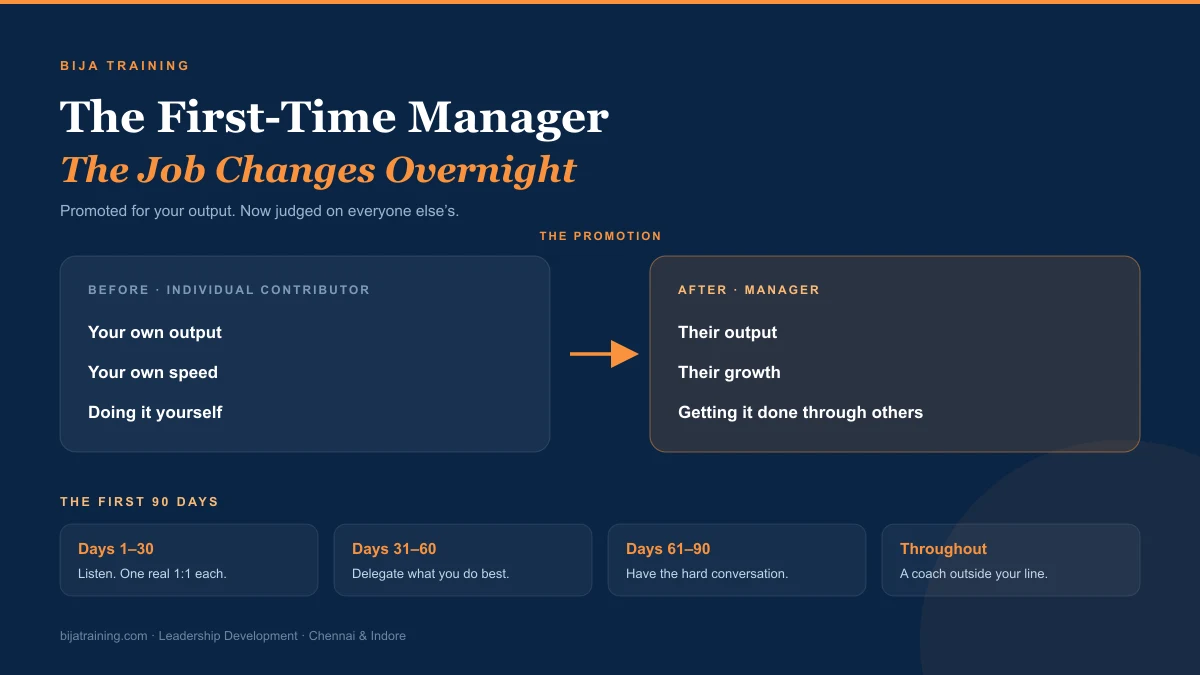
Bad management is not a rare event. It is the predictable result of a near-universal practice: promoting the strongest individual contributor and giving them no preparation whatsoever.
Almost every Indian organisation does this, and almost none of them account for what it costs. Training budgets get scrutinised line by line. The cost of not training gets no scrutiny at all, because it never appears in a single place where anyone could look at it.
Gallup has consistently found that the manager accounts for around 70% of the variance in team engagement. Set aside whether you find engagement scores persuasive; the structural point stands. The single largest lever over how a team performs is the person running it, and that person is typically the least-trained individual in the reporting line.
Where the Cost Actually Sits
1. Replacement cost
The one people do half-recognise. Recruitment fees or internal TA time, notice-period overlap, interviewing hours from people who have other jobs, onboarding, and the ramp to full productivity.
Commonly cited industry estimates put the total cost of replacing an employee somewhere between roughly half and two times their annual salary, rising sharply with seniority and specialisation. Those are broad ranges from varied methodologies, not a number you should quote in a board paper — but even the bottom of that range is not small when a team loses three people in a year.
2. The productivity gap around every exit
This is the bucket nobody counts, and it is often bigger than the first.
An employee who has decided to leave is rarely at full output for their last two months. The role then sits vacant. The replacement takes months to reach the productivity of the person who left. Across that whole arc you are paying for a seat that is delivering substantially less than it should.
Meanwhile the work does not pause. It gets absorbed by colleagues who are already loaded, which is precisely how a single resignation becomes two.
3. Disengagement in the people who stay
The largest bucket, and the hardest to see, because nothing visibly happens.
People under a manager they do not trust do not usually rebel. They narrow. They stop volunteering the idea, stop flagging the risk early, stop the discretionary half-hour that used to make the difference. Output stays acceptable and everything above acceptable quietly disappears.
You will not find this in any report. You find it later, in the gap between what a team was capable of and what it actually did.
4. Senior time spent firefighting
Every untrained manager generates escalations. Conflicts that should have been handled at source, decisions pushed upward, HR cases that began as a conversation nobody had six months earlier.
That time comes out of your most expensive people. An HR business partner spending a day a week on one team's grievances is a real cost, booked as salary and therefore never questioned.
A Back-of-Envelope Model You Can Run This Week
The following is illustrative arithmetic, not a benchmark. The point is the shape of the number, not the number. Run it with your own figures and you will get something defensible for your context.
Take one team of ten, average cost-to-company ₹10 lakh.
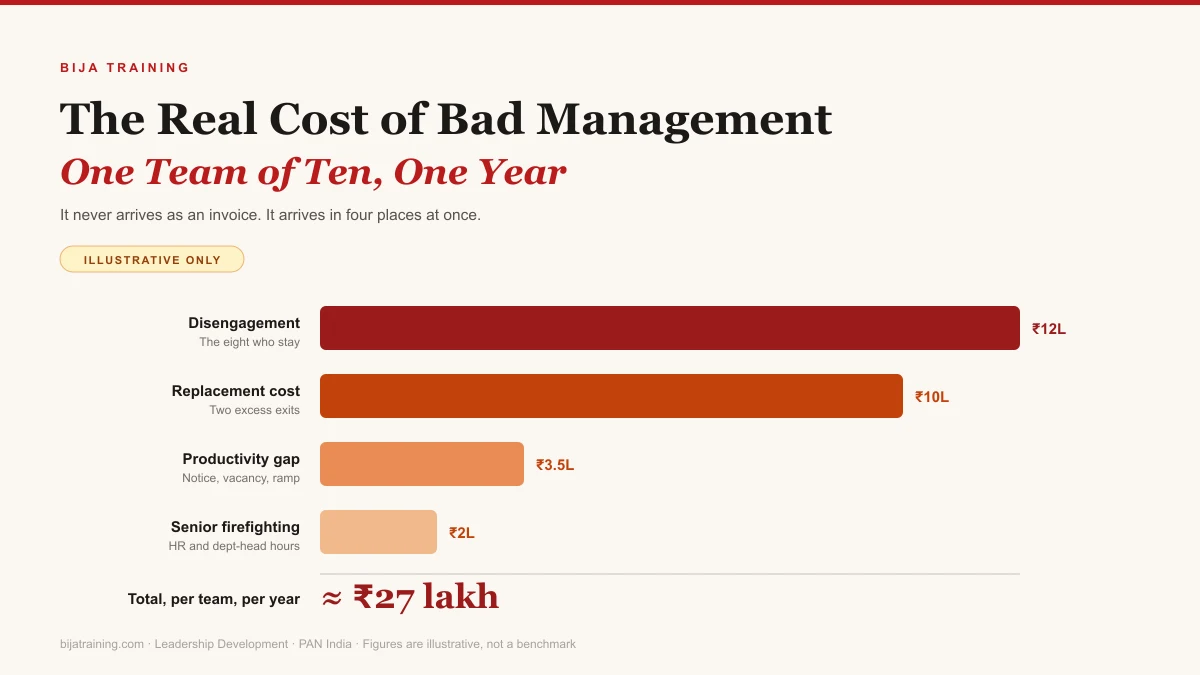
- Attrition. Say the team loses three people in a year against a company norm of one. Two excess exits, costed conservatively at half of annual salary each in replacement and ramp, is roughly ₹10 lakh.
- Productivity gap. Two roles running at reduced output across notice, vacancy and ramp — call it four months of substantially reduced delivery each. Even at half productivity, that is on the order of ₹3–4 lakh.
- Disengagement. The eight who stay, operating at perhaps 85% of what they would give a manager they trusted. On ₹80 lakh of salary, a 15% gap is ₹12 lakh of capability you are paying for and not receiving.
- Senior time. One HR partner and one department head, a few hours a week between them. Perhaps ₹2 lakh.
That lands somewhere near ₹27 lakh a year, for one team of ten.
Every input there is arguable, and the disengagement figure in particular is an estimate dressed as arithmetic — I would not defend it to a CFO as a measurement. What survives the argument is the order of magnitude. Halve every assumption and it is still lakhs per team per year, invisible, recurring, and currently unbudgeted.
Why This Never Reaches the Budget
Three structural reasons, and they compound.
It is distributed. Replacement cost sits with talent acquisition. Productivity sits with the business unit. Disengagement sits nowhere at all. No single owner ever sees the total.
It is counterfactual. You are comparing what happened against what would have happened under a competent manager — which nobody observed. That makes it easy to dismiss and hard to defend.
The alternative is legible and the status quo is not. A training proposal has a number on it and can be declined. The cost of declining has no number and cannot be declined, because it is already being paid.
This is the same measurement problem we unpack in our guide to measuring training ROI — and it cuts both ways. If you cannot put a number on the cost of inaction, you also cannot prove the value of acting.
The Comparison That Matters
The honest framing is not "training costs money". It is: you are already spending on this problem, and the only open question is whether you would rather spend it on prevention or on replacement.
A structured leadership programme for a cohort of managers typically costs a fraction of what a single mid-level replacement costs — you can see how our leadership development programmes are scoped and priced. Set against the model above, it does not need to work particularly well to pay for itself. It needs to prevent roughly one avoidable exit.
Which is a low bar, and the reason we usually recommend starting with the two or three managers where the pattern is clearest rather than training everyone at once. Most of the cost is concentrated in a small number of teams, and so is most of the available return. If your managers are newly promoted, the highest-leverage window is the first ninety days, before the habits set.
Frequently Asked Questions
What does bad management actually cost a company?
It sits in four buckets: replacement cost for people who leave, the productivity gap across notice periods and ramp-up, reduced discretionary effort from those who stay, and senior time absorbed by escalations. For a single team of ten, a conservative back-of-envelope model typically lands in the several-lakh-per-year range — illustrative, not a benchmark.
How much does it cost to replace an employee in India?
Commonly cited estimates range from roughly half to two times annual salary, rising with seniority and specialisation. These come from varied methodologies and should be treated as ranges rather than precise figures. The direct recruitment fee is usually the smallest component; ramp-to-productivity is the largest.
Why don't companies budget for the cost of untrained managers?
Because the cost is distributed across talent acquisition, business-unit P&L and unowned productivity loss, so no single person ever sees the total. It is also counterfactual — measured against a competent manager nobody observed — which makes it easy to dismiss in a budget discussion.
Is leadership training cheaper than replacing employees?
In most cases, substantially. A programme for a cohort of managers generally costs a fraction of one mid-level replacement, so it only has to prevent about one avoidable exit to pay for itself. The return concentrates in the small number of teams where the problem is worst.
How do I prove this cost to my CFO?
Do not lead with industry statistics. Build the model with your own attrition data, your own salary bands and explicitly stated assumptions, present it as a range, and name the weakest assumption yourself before anyone else does. A defensible estimate you volunteer the flaws in survives scrutiny better than a confident number you cannot source.
Where to Start
Pull voluntary attrition for the last two years, split by manager rather than by department. Departmental averages hide exactly what you are looking for.
In most organisations two or three names account for a disproportionate share. Run the arithmetic above on just those teams. That single page is usually the most persuasive training business case anyone in the room has seen — not because the numbers are exact, but because it is the first time the cost has appeared in one place.
We help HR and L&D teams build the cost-of-inaction case with their own data before designing anything. Get in touch for a conversation about your management layer, or see how we scope leadership development for organisations across India.